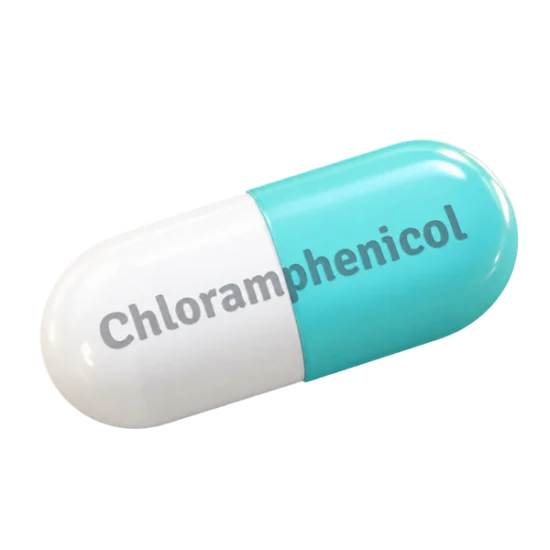
Chloramphenicol capsules are used for serious bacterial infections when more suitable antibiotics are not appropriate. The medicine helps control susceptible organisms by blocking bacterial protein production.
Product information
Chloramphenicol, the active ingredient of Chloramphenicol capsules, is a broad-spectrum phenicol antibiotic used for serious bacterial infections when more suitable antibiotics are not appropriate. It blocks bacterial protein production, helping control susceptible organisms while requiring careful dose selection because of rare but serious blood-related risks. Capsules are taken by mouth under an individually determined treatment plan.
Ingredients
Chloramphenicol contains the antibiotic chloramphenicol. It belongs to the phenicol class and has activity against a range of Gram-positive and Gram-negative bacteria, including some anaerobic organisms. Its spectrum is useful, yet systemic use is usually reserved for infections where clinical benefit outweighs its recognised bone-marrow toxicity risk [1].
The compound was first isolated from Streptomyces venezuelae, a soil-dwelling bacterium. Modern chloramphenicol is produced synthetically, which allows consistent pharmaceutical quality and avoids dependence on natural extraction.
Chloramphenicol is not a routine choice for viral colds, influenza, or uncomplicated sore throats. Antibiotics do not treat viruses, and unnecessary exposure adds avoidable adverse-effect risk.
Therapeutic indications
Oral Chloramphenicol capsules are used for serious infections caused by bacteria known or strongly suspected to be susceptible. It has a role in selected cases of typhoid fever, invasive Salmonella infection, bacterial meningitis, and certain infections where antimicrobial resistance limits other choices. The World Health Organization includes chloramphenicol in its Essential Medicines List for defined clinical uses [2].
Ophthalmic infections and target pathogens
Chloramphenicol is also used in eye formulations for bacterial conjunctivitis, though capsules are not the usual choice for a simple local eye infection. Common ocular pathogens can include Staphylococcus species, Haemophilus influenzae, and Streptococcus pneumoniae. Children can develop conjunctivitis from these bacteria, yet oral chloramphenicol requires stricter clinical assessment because infants and young children clear the drug less predictably.
Dosage and administration
The dose is decided individually, taking age, other medicines and health conditions into account. Treatment length also depends on the infection site, organism, clinical response, and laboratory findings.
Capsule administration
Swallow each capsule whole with water.
Take doses at the prescribed intervals each day.
Chloramphenicol may be taken with food if nausea occurs.
Continue for the exact treatment duration prescribed, even when symptoms improve earlier.
If a dose is missed, take it when remembered unless the next scheduled dose is near; do not take two doses together.
Nausea can make people delay or skip a capsule. Taking the dose after a light meal may improve comfort without reducing the need to keep to the prescribed schedule.
When not to use it
Chloramphenicol also needs avoidance or specialist-led use in the following situations:
existing severe bone-marrow disease or unexplained low blood counts;
newborn infants, because of the risk of grey baby syndrome;
pregnancy or breastfeeding, unless a prescriber judges that the expected benefit justifies exposure;
significant liver impairment, where accumulation is more likely;
treatment with medicines that can suppress bone marrow.
Chloramphenicol can inhibit liver enzymes involved in drug metabolism. It may increase exposure to warfarin, phenytoin, phenobarbital, sulfonylurea diabetes medicines, and some other drugs. Blood-count monitoring and drug-level monitoring may be needed during prolonged therapy.
The European Medicines Agency guidance on antibacterial development supports targeted antibiotic use based on likely pathogens, susceptibility data, and measurable clinical response rather than broad empirical treatment for every infection [4].
When this is not for you
This medication is not for you if you have a known allergy to chloramphenicol or a previous history of chloramphenicol-related bone-marrow suppression or aplastic anaemia.
Possible side effects
The key safety concern is bone-marrow toxicity. Dose-related bone-marrow suppression can occur during treatment and is often reversible after stopping the antibiotic. Aplastic anaemia is much rarer, unpredictable, and may occur after exposure even when treatment has ended. A systematic review of randomised trials found that chloramphenicol can retain a clinical role where alternatives are limited, while reinforcing the need for careful patient selection [3].
Common adverse effects can include:
nausea, vomiting, diarrhoea, or altered taste;
headache;
mouth soreness or inflammation;
reversible reductions in red cells, white cells, or platelets;
skin rash or fever from hypersensitivity.
Serious symptoms are uncommon but require prompt action. Unusual bruising, bleeding gums, persistent fever, sore throat, marked fatigue, mouth ulcers, pallor, or recurrent infections may indicate a blood-cell problem.
Mention any previous unexplained low blood count before treatment starts. A past episode of marrow suppression is clinically more relevant than ordinary short-lived stomach upset from an antibiotic.
How it affects the body
Chloramphenicol enters susceptible bacterial cells and reversibly binds to the 50S ribosomal subunit. Ribosomes are the cell structures that assemble proteins from amino acids. Once chloramphenicol occupies its binding site, it inhibits peptidyl transferase, the enzyme needed to link amino acids into a growing protein chain.
The drug also interferes with aminoacyl-tRNA positioning during peptide-chain elongation. Without functional protein synthesis, bacteria cannot multiply normally. This effect is usually bacteriostatic, meaning it stops bacterial growth and allows immune defences to clear the infection. Against a small number of highly susceptible organisms, activity can be bactericidal.
Ribosomal binding and enzyme blockade
Human cells have ribosomes too, but their structure differs from bacterial 70S ribosomes. Chloramphenicol therefore has selective antibacterial activity, although its ability to affect mitochondrial protein synthesis helps explain why bone marrow can be affected in susceptible people.
A useful clinical distinction is that chloramphenicol does not damage the bacterial cell wall. Beta-lactam antibiotics act through cell-wall synthesis, while chloramphenicol acts inside the cell at the protein-production stage.
Take each dose at evenly spaced times. Irregular gaps can produce periods when antibiotic exposure is too low to suppress bacterial growth.
Common mistakes
Stopping once fever or pain improves, before the prescribed course is complete.
Doubling the next dose after forgetting one.
Crushing, chewing, or opening capsules without specific instruction.
Taking chloramphenicol alongside another person’s antibiotic plan.
Ignoring new bruising, mouth ulcers, fever, or severe fatigue.
Forgetting to report anticoagulants, anti-seizure medicines, or diabetes treatment.
Keep a simple written record of dose times and any new symptoms. This is more useful than relying on memory when treatment involves several medicines or changing work shifts.
Comparison
Chloramphenicol is valued for intracellular penetration and broad activity, yet it is not automatically the first option for systemic bacterial infection. Drug selection depends on infection site, culture results, age, kidney and liver function, allergy history, and marrow risk.
Antibiotic approach
Main mechanism
Typical clinical positioning
Chloramphenicol
Inhibits 50S ribosomal protein synthesis
Selected serious infections when benefit justifies marrow-related risk
Third-generation cephalosporins such as cefotaxime or ceftriaxone
Disrupt bacterial cell-wall formation
Frequently used for susceptible severe infections, including many meningitis protocols
Fluoroquinolones
Inhibit bacterial DNA gyrase and topoisomerase
Used for selected urinary, gastrointestinal, respiratory, or resistant infections
Cefotaxime and ceftriaxone are beta-lactam antibiotics with a different safety profile and are often considered when the organism is susceptible. Fluoroquinolones have useful tissue penetration, though tendon, nerve, glucose, and rhythm-related adverse effects can limit their use. Rifampin may be combined with other antibiotics in specific infections because resistance develops quickly if it is used alone.
WHO’s AWaRe framework encourages antibiotic choices that balance clinical effectiveness with antimicrobial-resistance stewardship [5].
What doctors say
In clinical practice, doctors reserve oral chloramphenicol for serious bacterial infections when more suitable antibiotics are not appropriate. The expected benefit is control of a proven or strongly suspected susceptible infection by blocking bacterial protein production, rather than immediate relief after the first capsule.
Doctors determine the dose and treatment length individually, considering age, other medicines, health conditions, infection site, clinical response, and laboratory findings. Because chloramphenicol carries rare but serious blood-related risks, careful treatment planning and monitoring are important.
A broad-spectrum antibiotic is not automatically the preferred option. Chloramphenicol is used selectively when it is suitable for the infection and other choices are not appropriate.
Can Chloramphenicol capsules be split, crushed, or chewed?
Chloramphenicol capsules should be swallowed whole unless a prescriber gives a different instruction. Crushing or opening a capsule can make an unpleasant taste more noticeable and may lead to loss of part of the dose. FDA prescribing information for chloramphenicol capsules describes oral use under a clinician-directed dosing plan, with dose choice based on the infection and patient factors. The 2018 FDA information also highlights the need to use the drug only when its expected benefit is clear. A pharmacist can confirm the available formulation if swallowing is difficult.
Does Chloramphenicol cause bone-marrow suppression?
Yes. Chloramphenicol can cause dose-related, usually reversible bone-marrow suppression, and it has also been linked to rare idiosyncratic aplastic anaemia. The WHO Essential Medicines List published in 2023 retains chloramphenicol for defined indications, reflecting that its benefits remain relevant in selected infections. New bruising, bleeding, fever, sore throat, mouth ulcers, or unusual tiredness require urgent medical assessment.
What is the best time of day to take Chloramphenicol?
The best timing is the schedule set by the prescriber, with doses spaced as evenly as possible across the day and night. A morning-only routine may not maintain suitable antibiotic exposure if several daily doses have been prescribed. WHO’s 2023 AWaRe guidance supports using antibiotics in a structured regimen that matches the infection and pharmacological properties of the medicine. Taking capsules with a light meal can help if stomach upset occurs.
Can Chloramphenicol affect driving, concentration, or machinery work?
Chloramphenicol does not commonly cause marked sedation, yet headache, dizziness, weakness, or visual disturbance can affect concentration in some people. Avoid driving, operating machinery, or working at height if you feel unwell, light-headed, or unable to focus normally. EMA antibacterial-treatment guidance, revised in 2022, places patient safety and adverse-effect monitoring alongside infection control. Resume demanding tasks only when you feel mentally alert and physically steady.
Which symptoms mean I should stop Chloramphenicol and seek urgent medical care?
Stop the capsules and seek urgent assessment for rash with facial swelling, breathing difficulty, severe or persistent diarrhoea, unusual bleeding, bruising, high fever, mouth ulcers, profound weakness, or a grey-blue skin tone in an infant. These symptoms can signal an allergic reaction, significant gastrointestinal complication, blood-cell toxicity, or impaired drug clearance. A 2019 systematic review indexed in PubMed identifies haematological toxicity as the adverse effect that drives the need for close clinical caution with systemic chloramphenicol. Do not restart treatment after a serious suspected reaction unless a prescriber has assessed the cause.
Do you offer anonymous delivery?
Your order will be securely packed and shipped within 24 hours. This is exactly what your package will look like (images of an actual item sent). It has the size and look of a regular private letter (24x11x0.7 cm) and its contents cannot be seen.
Sources
World Health Organization (2023). WHO Model List of Essential Medicines: 23rd List.
U.S. Food and Drug Administration (2018). Chloramphenicol Capsules USP Prescribing Information.
PubMed (2019). Efficacy and safety of chloramphenicol: a systematic review and meta-analysis of randomised controlled trials.
European Medicines Agency (2022). Guideline on the evaluation of medicinal products indicated for treatment of bacterial infections.
World Health Organization (2023). The WHO AWaRe Antibiotic Book.
Reviews: Chloramphenicol
I
Imran, 43
Umm Al Quwain
Verified
Rating: 5 out of 5
I took the prescribed Chloramphenicol capsules at the prescribed dose for the full prescribed course for a confirmed bacterial infection. My fever settled over the next few days, and I was able to return to my normal work routine after finishing the course.
9 Nov 2026
H
Hamdan, 43
Ajman
Verified
Rating: 2 out of 5
I started the capsules at the prescribed dose for a bacterial infection and took them for several doses, but developed persistent nausea and felt unusually tired after several doses. I stopped taking them and spoke with my doctor, who changed the treatment plan.
12 Oct 2026
A
Ali, 36
Mirdif
Verified
Rating: 5 out of 5
I used Chloramphenicol capsules at the prescribed dose and exactly at the scheduled times for the full course of treatment for my infection. The pain and fever improved steadily, and the follow-up confirmed that the infection had cleared.