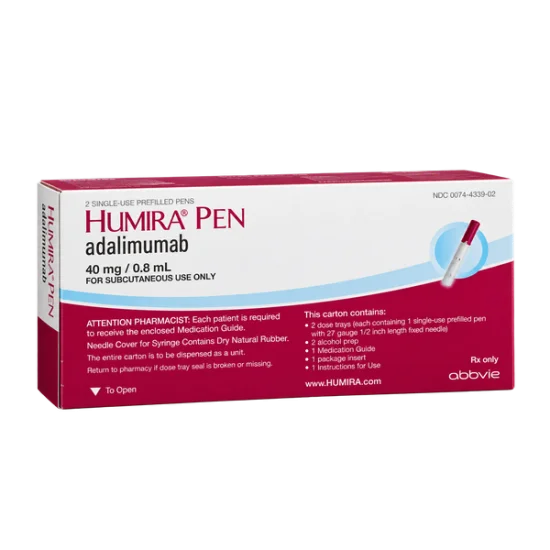
Injected beneath the skin with a prefilled pen, Humira contains adalimumab, a treatment for several inflammatory conditions. By blocking an immune-system signal called tumour necrosis factor alpha (TNF-alpha), it can reduce inflammation and help protect affected joints and tissues.
Product information
It is used in adults with conditions including rheumatoid arthritis, plaque psoriasis and Crohn’s disease.
Adalimumab is a monoclonal antibody: a laboratory-made protein designed to bind a specific target.
Ingredients
Each single-use Humira pen contains adalimumab for subcutaneous injection. The regimen for the chosen strength is confirmed with a healthcare professional before starting. Adalimumab is a monoclonal antibody: a laboratory-made protein designed to bind a specific target. Its target, TNF-alpha, helps coordinate inflammation. When TNF-alpha activity remains high, it can contribute to joint swelling, skin plaques or intestinal inflammation.
Pharmacological classification of adalimumab
Adalimumab is a biologic disease-modifying treatment and a TNF-alpha inhibitor. “Biologic” refers to a medicine made using living-cell processes rather than a small chemically synthesised molecule. Its effects develop over repeated treatment, so a single injection cannot establish whether Humira will control a chronic condition. The regimen for the chosen strength is confirmed with a healthcare professional before starting.
Therapeutic indications
Humira treats several immune-mediated conditions when a specialist judges TNF-alpha inhibition appropriate. The treatment goal differs by disease: fewer swollen joints, clearer skin or sustained control of intestinal symptoms. Some conditions require a starting regimen before regular maintenance injections.
Condition
Inflammation targeted
Treatment goal
Rheumatoid arthritis
Joint lining and surrounding tissue
Reduce pain and swelling; limit joint damage
Plaque psoriasis
Inflamed skin
Reduce the extent and severity of plaques
Crohn’s disease
Digestive-tract lining
Control symptoms and maintain remission
Humira also has uses in other conditions, including psoriatic arthritis, ankylosing spondylitis, ulcerative colitis, hidradenitis suppurativa and certain forms of uveitis. Age criteria vary by indication.
Treatment schedules also vary. A useful distinction in rheumatoid arthritis is that feeling less pain is only part of the goal: clinicians also assess swelling and disease activity because joint damage can progress between appointments. NICE guidance places biologic treatment within a wider plan that measures disease control over time [2].
Dosage and administration
This presentation contains two single-use prefilled pens. The regimen for the chosen strength and condition is confirmed with a healthcare professional before starting.
Route: Inject subcutaneously into the abdomen or front of the thigh, using the technique taught by the clinical team.
Timing: Follow the condition-specific schedule rather than injecting whenever symptoms return.
Injection sites: Rotate sites and avoid skin that is bruised, tender, red or affected by psoriasis.
Missed injection: Take it when remembered, then discuss the timing of the next injection with the treating team. Do not double an injection to catch up.
Humira pens require refrigeration at 2–8°C and must not be frozen.
Before an injection, allowing a refrigerated pen to reach room temperature naturally can make the injection more comfortable. Do not heat it in hot water or a microwave.
Pick a consistent day for scheduled injections. A calendar reminder helps distinguish a missed dose from a planned gap in a condition-specific regimen.
A brief sting can occur even with correct technique. Rotating between suitable areas is more useful than repeatedly choosing the least-sensitive spot.
When not to use it
Humira is not for you if you have active tuberculosis, another serious active infection, or a known severe allergy to adalimumab or its ingredients. It should also be avoided in moderate to severe heart failure. A specialist assesses any history of cancer, demyelinating disease such as multiple sclerosis, hepatitis B, or recurrent infections before treatment.
Screening for tuberculosis is a key pre-treatment step. A person may carry latent tuberculosis without feeling ill; TNF-alpha helps keep that infection contained. WHO guidance on tuberculosis prevention explains why identifying and managing latent infection matters before immune-suppressing treatment [3].
Treatment or exposure
Main concern
Practical implication
Live vaccines
Infection from a weakened live organism
Plan required live vaccinations before treatment; avoid them during Humira therapy
Anakinra or abatacept
Greater risk of serious infection
Do not combine with Humira
Other immune-suppressing medicines
Infection risk may increase
The specialist weighs the combination against the condition being treated
Pregnancy and breastfeeding require a condition-specific discussion. Adalimumab can cross the placenta, especially later in pregnancy, so a clinician needs to know about exposure when planning an infant’s live vaccinations.
When this is not for you
Do not use Humira if you have active tuberculosis, another serious infection or a severe allergy to adalimumab or its ingredients. It may not be suitable if you have moderate to severe heart failure, a history of cancer, multiple sclerosis or another demyelinating disease, hepatitis B or repeated infections. Tell your clinician about pregnancy, breastfeeding, live vaccines and other medicines that suppress the immune system.
Possible side effects
Injection-site redness, itching, discomfort or swelling are among the common effects of adalimumab. Headache and respiratory infections can also occur. A local reaction is often short-lived, but spreading redness, marked warmth or worsening pain deserves assessment because it may indicate an infection.
More serious risks include tuberculosis and other severe infections, hepatitis B reactivation, certain blood disorders and, rarely, neurological or severe allergic reactions. Humira can also worsen heart failure in susceptible people. The benefits of controlling destructive inflammation have to be weighed against these risks for the individual condition and medical history.
Record the date and location of a troublesome injection-site reaction. That helps the clinical team tell a recurring local reaction from a problem at one particular site.
How it affects the body
Adalimumab binds TNF-alpha before that signal can activate its receptors on cells. This reduces inflammatory activity; it does not switch off every part of the immune system. The same action also increases susceptibility to certain infections, which is why screening before treatment matters [1].
Common mistakes
Using symptom return as the dosing schedule. Humira is intended for planned treatment, not occasional relief when a flare becomes noticeable.
Assuming every fever is part of the underlying condition. Fever, a persistent cough or painful urination can signal an infection that needs assessment before the next injection.
Injecting into irritated skin. This can make discomfort worse and complicate assessment of a skin reaction.
Forgetting vaccination plans. Live vaccines need discussion before biologic treatment begins.
Judging success from one good or bad day. Disease activity is assessed over time, often with examination or laboratory tests as well as symptoms.
Before a planned procedure or dental treatment, tell the treating clinician that you use adalimumab. The decision about injection timing depends on infection risk and disease control.
Comparison
An adalimumab biosimilar is a biologic shown to be highly similar to a reference adalimumab medicine, with no clinically meaningful differences in the assessed uses. Biosimilars are evaluated through detailed comparisons of their structure, activity, quality and clinical performance. They are not treated as simple chemical copies; the EMA explains the distinct evidence standards used for biologics [4].
Approach
How it acts
Main consideration
Humira
Blocks TNF-alpha with adalimumab
Established option with condition-specific injection schedules
Adalimumab biosimilar
Blocks TNF-alpha with a highly similar biologic
Device technique and approved indications need review when switching
Non-TNF biologic
Targets a different immune pathway
May suit a person whose disease or treatment history calls for another mechanism
A change between biologic treatments is a clinical decision, not an adjustment to make between scheduled injections. Device training matters even when the active substance is adalimumab: small differences in how an injector operates can affect confidence and technique.
What doctors say
In clinical practice, specialists look beyond whether a patient felt better immediately after an injection. They assess the measures that matter for the underlying disease: swollen-joint counts in arthritis, skin involvement in psoriasis, or symptoms alongside tests of intestinal inflammation in Crohn’s disease.
Response takes time. Results vary by condition. A rheumatologist may also continue another disease-modifying medicine alongside Humira when the combination is appropriate, while monitoring for infections. Reporting a new infection promptly is more useful than silently skipping several injections and losing track of disease control.
Yes, age alone does not rule out adalimumab. Older adults may have a higher risk of serious infection, especially when other health conditions or immune-suppressing treatments are present. The EMA’s Humira product information available in 2026 supports assessing infection risk and monitoring symptoms throughout treatment.
Which symptoms require urgent medical attention or stopping an injection?
Seek urgent assessment for breathing difficulty, facial or throat swelling, faintness, or signs of a severe infection such as persistent high fever with marked weakness. A persistent cough, night sweats or unexplained weight loss also needs prompt assessment because tuberculosis can develop during TNF-alpha inhibition. The EMA’s 2023 product information advises against administering Humira during a serious active infection; a clinician determines when treatment can resume.
Can Humira affect driving, concentration or work with machinery?
Humira may cause dizziness or visual disturbance in some people. Do not drive or operate machinery if those symptoms occur after an injection. The EMA’s product information available in 2026 describes a minor potential influence on these activities, so the practical decision depends on how the individual feels.
Can people under 18 use Humira?
Adalimumab has paediatric uses for selected inflammatory conditions, but eligibility depends on the diagnosis, age and specialist-directed regimen. Adult treatment instructions should not be applied to a child. The EMA’s Humira indications available in 2026 include specific paediatric conditions with their own dosing requirements.
How long does one Humira injection keep working?
Adalimumab has a long elimination half-life, typically around two weeks, but that does not mean every person gets two weeks of symptom control from one injection. The treatment schedule is designed to maintain an effect across repeated doses, and some conditions need a different starting schedule. The EMA’s pharmacokinetic information available in 2026 describes how adalimumab remains in the body; symptom response still needs clinical assessment.
Does Humira cause injection-site reactions?
Yes. Redness, itching, pain or swelling at the injection site are common with adalimumab, according to the EMA’s Humira safety information available in 2026. These reactions often settle, while a reaction that becomes increasingly hot, painful or widespread needs assessment. Rotating suitable injection sites can help reduce repeated irritation in one area.
Can I drink alcohol while using Humira?
There is no specific direct alcohol interaction listed for adalimumab in the EMA’s Humira product information available in 2026. Alcohol can still matter if treatment also includes medicines that affect the liver, or if the underlying condition causes liver problems. Heavy drinking can make illness symptoms harder to interpret, so the full treatment plan matters more than adalimumab alone.
Do you offer anonymous delivery?
Your order will be securely packed and shipped within 24 hours. This is exactly what your package will look like (images of an actual item sent). It has the size and look of a regular private letter (24x11x0.7 cm) and its contents cannot be seen.
Sources
European Medicines Agency (2023). Humira: EPAR — Product information.
National Institute for Health and Care Excellence (2018). Rheumatoid arthritis in adults: management.
World Health Organization (2020). WHO consolidated guidelines on tuberculosis: Module 1: Prevention — tuberculosis preventive treatment.
European Medicines Agency (2017). Biosimilars in the EU: Information guide for healthcare professionals.
Reviews: Humira
A
Ahmed, 38
Kalba
Several months
Verified
Rating: 3 out of 5
I used the pen on my scheduled days for several months. My morning stiffness eased, although the injection area sometimes stayed red until the next day.
19 Oct 2026
R
Rachel A., 51
Al Qusais
A few months
Verified
Rating: 4 out of 5
After a few months of scheduled injections, the plaques on my elbows covered less skin. I found it easier to wear short sleeves again.
1 Nov 2026
S
Suresh, 45
Mirdif
Several months
Verified
Rating: 5 out of 5
I kept to my injection schedule over several months. I had fewer urgent trips to the bathroom and could plan my workday more easily.