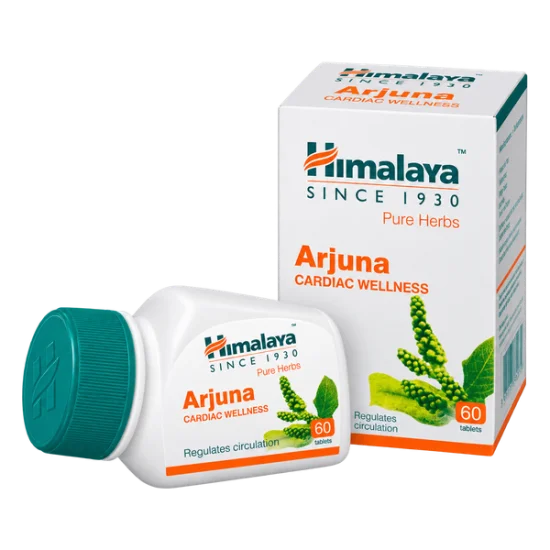
Arjuna
4 (5 customer reviews)Cardiovascular wellness includes supporting normal circulation and healthy heart function. Arjuna tablets contain Terminalia arjuna bark, a traditional botanical valued for antioxidant phytochemicals that may support cardiovascular balance.
Product information
Terminalia arjuna, often called the Arjun tree, is a large deciduous tree native to the Indian subcontinent. Traditional herbal practice uses the thick outer bark rather than the leaves, flowers, or Terminalia arjuna seeds, because the bark contains the plant compounds most studied for cardiovascular support.
The Arjun tree belongs to the Combretaceae family. Its bark has a pale grey exterior and a dense inner structure rich in triterpenoids, flavonoids, tannins, and glycosides. Research reviews describe its long history in Ayurvedic practice for supporting cardiac comfort and circulation, while also stressing that modern clinical evidence is still limited by small study sizes. [1]
Ingredients
Arjuna contains several naturally occurring phytochemicals rather than one isolated drug substance. The main researched compounds include arjunolic acid, arjunic acid, arjungenin, flavonoids, glycosides, tannins, and triterpenoid saponins.
Triterpenoids are plant-derived molecules with ring-shaped chemical structures. Flavonoids are antioxidant compounds found across many plants. Glycosides are molecules in which a sugar component is linked to another active chemical structure. Together, these constituents may help explain why arjuna bark has been investigated for oxidative stress and cardiovascular function.
Arjunolic acid has attracted attention for antioxidant and cell-protective effects in laboratory research. Arjungenin and arjunic acid are related triterpenoids. Laboratory findings are useful for understanding possible mechanisms, yet they cannot predict the same effect in every person taking a tablet.
Role of triterpenoid saponins in cellular defence
Triterpenoid saponins may influence inflammatory signalling and membrane stability in experimental models. This does not mean they act like prescription anti-inflammatory or cholesterol-lowering medicines.
A 2017 review in the Journal of Traditional and Complementary Medicine describes Terminalia arjuna as a phytochemically complex botanical with antioxidant, lipid-related, and cardiotonic research interest. Human trials remain the key evidence gap. [3]

Therapeutic indications
Early clinical research has explored Terminalia arjuna in people with stable angina, altered lipid markers, and reduced exercise tolerance. These studies suggest possible benefits for exercise capacity and lipid balance, though they do not establish Arjuna as a replacement for treatment of coronary artery disease, hypertension, arrhythmia, or heart failure.
Potential areas of support include:
- Maintenance of healthy circulation through antioxidant activity
- Support for normal endothelial function, meaning the function of blood-vessel lining cells
- Contribution to balanced lipid metabolism
- Traditional support for myocardial strength and physical stamina
- A tablet format that avoids brewing Arjuna bark preparations
Dosage and administration
Take Arjuna tablets orally with water at a regular time each day. Dosing differs between strengths and between users, so there is no single amount that suits everyone.
A practical routine is:
- Use the individual daily regimen selected for your health needs.
- Take the tablet at the same time each day to reduce missed doses.
- If it causes mild stomach discomfort, taking it with a meal may be more comfortable.
- Do not double the next intake after a missed tablet. Resume the usual routine instead.
- Track blood pressure, pulse, chest symptoms, and laboratory results when these are already being monitored for a cardiovascular condition.
Traditional preparations and tablet convenience
Traditional Ksheerapaka is a milk-based herbal decoction prepared from bark material, while water decoctions are made by simmering bark in water. These methods can be time-consuming and may produce variable concentrations of plant compounds.
Tablets remove the need for simmering or straining. They should be swallowed whole unless a clinician has specifically advised another approach.
When not to use it
Extra caution is needed in the following situations:
- Use of anticoagulants or antiplatelet medicines, because changes in bleeding tendency may be clinically relevant
- Use of blood-pressure medicines, because dizziness or low blood pressure can become more likely
- Use of glucose-lowering treatment, especially when blood glucose is already tightly controlled
- Pregnancy or breastfeeding, where reliable safety data for Arjuna supplementation are insufficient
- Upcoming surgery or dental procedures, when the full supplement list should be reviewed in advance
- Existing angina, heart failure, valve disease, arrhythmia, or previous heart attack
When this is not for you
This is NOT for you if you have had an allergic reaction to Terminalia arjuna or another component of the tablets.
Arjuna should not be used to delay care for exertional chest pressure, pain spreading to the arm or jaw, unexplained breathlessness, swelling of the legs, or sudden marked fatigue. In the UAE, a MOHAP-licensed clinician can assess whether a cardiovascular supplement fits alongside prescribed treatment.
Possible side effects
Arjuna is generally used as a well-tolerated botanical supplement, but natural origin does not eliminate the possibility of side effects. Mild digestive discomfort, nausea, loose stools, constipation, headache, or dizziness can occur in sensitive users.
Stop using Arjuna and seek urgent care for facial swelling, wheezing, widespread hives, fainting, severe chest pain, or symptoms of significant bleeding. These reactions are uncommon, yet they need prompt attention.
People using Arjuna for cardiovascular wellness sometimes expect a noticeable sensation, such as a stronger heartbeat or instant energy. That is not a reliable sign that the product is working. Benefits, where they occur, are usually assessed through longer-term wellbeing, exercise tolerance, and clinician-reviewed cardiovascular markers.
How it affects the body
Arjuna is used to support normal circulation, vascular tone, and cardiac wellness. Its phytochemicals may help limit oxidative stress, which refers to cellular damage caused when reactive oxygen compounds exceed the body’s protective antioxidant systems.
Arjuna bark contains tannins and triterpenoid compounds that may influence lipid oxidation and hepatic lipid handling. Reduced oxidation of low-density lipoprotein particles is one proposed pathway, since oxidised LDL contributes to atherosclerotic plaque formation.
Common mistakes
Several avoidable habits reduce the value of an Arjuna routine or increase risk.
- Replacing prescribed blood-pressure, cholesterol, or antianginal treatment with a botanical tablet
- Using Arjuna intermittently, then judging results after only a few doses
- Taking it alongside several circulation-focused supplements without reviewing the combined effect
- Ignoring dizziness after combining it with medicines that lower blood pressure
- Assuming chest pain is harmless because a heart-support supplement is being used
- Crushing or chewing tablets without a specific instruction to do so
Swallowing the tablet whole is usually the simplest approach. Crushing can make the taste unpleasant and may make a daily routine harder to maintain.
Comparison
Arjuna can be a useful supportive botanical, but it does not produce the immediate vessel-relaxing effect associated with nitric oxide supplements. It also does not replace medicines prescribed to manage blood pressure, angina, cholesterol, clotting, or heart rhythm.
| Approach | Main mechanism | Practical role |
|---|---|---|
| Arjuna bark tablets | Antioxidant polyphenols and triterpenoids supporting cardiovascular function | Gradual daily wellness support |
| Hawthorn berry preparations | Flavonoid-rich extracts studied for cardiac symptoms and exercise tolerance | Herbal option with different extract profiles |
| Nitric oxide supplements | Support nitric oxide pathways involved in blood-vessel relaxation | Often used around exercise rather than as a cardiac botanical |
Hawthorn has been studied in chronic heart failure, yet it can also interact with cardiovascular therapy. Herbal products should not be treated as interchangeable simply because they are both associated with heart health. [2]
What doctors say
Clinicians tend to view Arjuna as a supportive botanical rather than a substitute for cardiovascular medicines with proven outcome benefits. It may suit adults seeking a structured herbal addition to healthy lifestyle measures, provided there is no conflict with their current treatment.
Doctors also look for the reason a person wants cardiac support. A person with borderline lifestyle-related risk factors needs a different approach from someone with diagnosed coronary artery disease or persistent high blood pressure. The useful clinical question is not whether a herb is “strong,” but whether it fits safely with the person’s medicines, symptoms, medical history, and monitoring.
The WHO’s 2025–2034 traditional medicine strategy supports better research, quality assurance, and appropriate integration of traditional practices into health systems. [4]
Comparison
Common questions
What should I do if I do not notice the expected result from Arjuna?
Arjuna is not expected to create an immediate or dramatic sensation. Review the goal first: support for cardiovascular wellness differs from treatment for chest pain, hypertension, or high cholesterol. A 2017 review in the Journal of Traditional and Complementary Medicine found that clinical evidence for Terminalia arjuna needs stronger, larger trials. If symptoms such as chest discomfort, breathlessness, or dizziness persist, they need medical assessment rather than a higher supplement intake.
What is the best time of day to take Arjuna?
A consistent time of day matters more than a universally “best” hour. Many people find a meal-time routine easier to remember and more comfortable for the stomach. The WHO strategy published in 2025 emphasises appropriate use of traditional medicine within personal health needs, which includes considering prescribed medicines and daily routines. If you use blood-pressure treatment, ask a clinician whether separating timing would be sensible for your situation.
Can Arjuna be combined with blood-pressure medicines?
Arjuna may add to the blood-pressure-lowering effect of antihypertensive medicines in some people. This could contribute to light-headedness, weakness, blurred vision, or feeling faint when standing up. The EMA’s 2011 herbal-quality guidance supports careful evaluation of botanical products and their clinical use. People taking antihypertensives should have their full medicine and supplement list reviewed before starting Arjuna.
Can Arjuna tablets be split, crushed, or chewed?
Swallowing tablets whole with water is the preferred routine unless a clinician has advised a different method. Splitting, crushing, or chewing may leave a bitter herbal taste and can make the intake less pleasant. The 2007 Journal of Ethnopharmacology review describes the complex phytochemical nature of Terminalia arjuna bark, rather than an isolated single compound. A whole-tablet routine also makes daily use easier to track.
How long does one Arjuna tablet keep working?
Arjuna is not used as an on-demand product with a predictable hour-by-hour duration. Its intended role is regular botanical support, and any perceived benefit is usually judged over a sustained routine rather than after one tablet. The WHO’s 2025 traditional medicine strategy calls for better evidence on effectiveness, safety, and appropriate use of traditional products. Do not take an extra tablet for sudden chest symptoms or fatigue.
Do you offer anonymous delivery?
Your order will be securely packed and shipped within 24 hours. This is exactly what your package will look like (images of an actual item sent). It has the size and look of a regular private letter (24x11x0.7 cm) and its contents cannot be seen.
Sources
- Journal of Ethnopharmacology (2007). Terminalia arjuna Wight & Arn.—A useful drug for cardiovascular disorders.
- Cochrane Database of Systematic Reviews (2008). Hawthorn extract for treating chronic heart failure.
- Journal of Traditional and Complementary Medicine (2017). Medicinal properties of Terminalia arjuna (Roxb.) Wight & Arn.: A review.
- World Health Organization (2025). WHO global traditional medicine strategy 2025–2034.