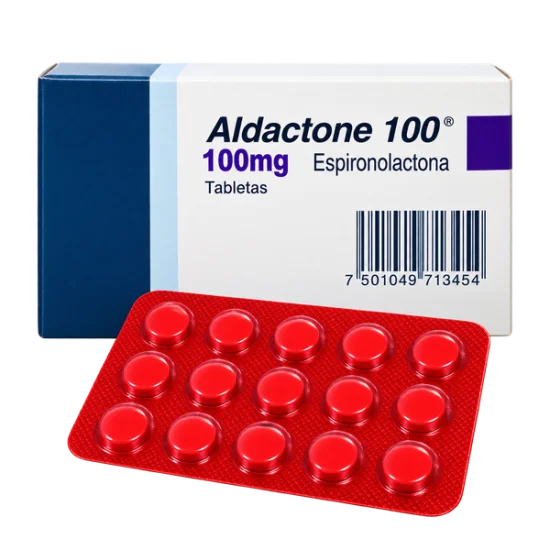
By blocking the effects of aldosterone in the kidneys, spironolactone in Aldactone helps the body release excess sodium and water while retaining potassium. Aldactone is used for adults with fluid retention, hypertension, heart failure, liver-related ascites, or excess aldosterone production.
Product information
Aldactone contains spironolactone, a potassium-sparing diuretic and aldosterone antagonist. Aldosterone is a hormone that signals the kidneys to retain sodium and water while excreting potassium. Spironolactone blocks this signal at mineralocorticoid receptors in the distal renal tubules, so more sodium and water leave through urine while potassium is conserved [1].
Ingredients
Aldactone contains spironolactone, a potassium-sparing diuretic and aldosterone antagonist.
Therapeutic indications
Aldactone is prescribed for several cardiovascular, kidney, liver, and endocrine indications. The therapeutic goal changes with the diagnosis: fluid reduction in oedema, blood-pressure lowering in hypertension, or aldosterone blockade in primary hyperaldosteronism. NICE heart-failure guidance includes mineralocorticoid receptor antagonists such as spironolactone for eligible patients with reduced ejection fraction who remain symptomatic despite foundational treatment [2].
Clinical use
Typical patient group
Main treatment goal
Hypertension
Adults with persistent high blood pressure
Reduce sodium retention and support blood-pressure control
Heart failure
Adults with fluid overload or reduced ejection fraction
Limit aldosterone-related fluid retention and cardiac strain
Ascites or oedema
People with liver cirrhosis or selected kidney conditions
Reduce swelling and abdominal fluid accumulation
Primary Hyperaldosteronism Management
Primary hyperaldosteronism occurs when the adrenal glands produce too much aldosterone. This can lead to hypertension and low potassium, though potassium may remain within range in some people. Because spironolactone blocks aldosterone receptors directly, it addresses the hormone pathway driving the problem.
MOHAP, the UAE Ministry of Health and Prevention, is the national authority relevant to medicine regulation and healthcare policy. For endocrine indications, clinicians usually use blood pressure, potassium, renal function, and hormone investigations together rather than judging response from symptoms alone.
Dosage and administration
Aldactone on this page is supplied as oral spironolactone tablets. The tablet strength is not automatically the right daily amount for every condition. The regimen for the chosen strength is confirmed with a healthcare professional before starting, then adjusted according to the reason for treatment, blood pressure, fluid status, kidney function, and serum potassium.
For oral use:
Swallow the tablet whole with water.
Take it at the same time each day.
Morning use is often more convenient if increased urination occurs.
Take a missed dose when remembered unless the next scheduled dose is close.
Do not take two doses together to make up for a forgotten tablet.
The World Health Organization lists spironolactone as an essential medicine, reflecting its established role in appropriate clinical settings [3].
When not to use it
Aldactone is not for you if you have anuria, acute kidney failure, significant renal impairment with high potassium, Addison’s disease, or known hypersensitivity to spironolactone. It should also be avoided when hyperkalaemia is already present.
Extra caution is needed in these situations:
Chronic kidney disease or rapidly changing kidney function
Concurrent potassium supplements or potassium-containing salt substitutes
Treatment with lisinopril, losartan, trimethoprim, ciclosporin, or other potassium-raising medicines
Dehydration from vomiting, diarrhoea, fever, or poor fluid intake
Pregnancy or breastfeeding, where treatment decisions require individual clinical assessment
When this is not for you
Aldactone is not for you if you have anuria, acute kidney failure, significant renal impairment with high potassium, Addison’s disease, or known hypersensitivity to spironolactone. It should also be avoided when hyperkalaemia is already present.
Alcohol can worsen dizziness or low blood pressure in people taking diuretics. NSAID pain relievers may also reduce the diuretic response and affect kidney function, especially during dehydration.
Possible side effects
Hyperkalaemia, meaning raised potassium in the blood, is the most clinically significant risk with Aldactone. Mild elevations may cause no symptoms. More serious elevations can affect heart rhythm and may cause weakness, tingling, nausea, an irregular heartbeat, or fainting.
Commonly reported effects include:
Increased urination
Dizziness, especially when standing quickly
Nausea, abdominal discomfort, or diarrhoea
Headache or fatigue
Breast tenderness or enlargement
Reduced libido or erectile difficulties in some men
Menstrual irregularities in some women
Spironolactone also has anti-androgen activity, which explains why breast tenderness, gynaecomastia, menstrual changes, and sexual side effects can occur. These effects are dose-related for some patients and can become a deciding factor when treatment is prolonged. The FDA prescribing information describes hyperkalaemia, renal impairment, and endocrine effects among the key safety issues for spironolactone treatment [4].
Do not treat muscle cramps by adding an electrolyte drink or potassium supplement on your own. With Aldactone, cramps can have several causes, and extra potassium may be unsafe.
How it affects the body
Aldosterone is a hormone that signals the kidneys to retain sodium and water while excreting potassium. Spironolactone blocks this signal at mineralocorticoid receptors in the distal renal tubules, so more sodium and water leave through urine while potassium is conserved [1].
This action differs from loop diuretics such as furosemide, which act earlier in the kidney and can lower potassium. Its main value is reducing the hormonal drive to retain salt and fluid.
Common mistakes
The most common mistake is assuming that a potassium-sparing diuretic needs a potassium supplement. Aldactone reduces potassium loss, so adding supplements, electrolyte powders, or salt substitutes can be harmful without a specific clinical reason.
Other avoidable problems include:
Taking a forgotten dose together with the next dose
Stopping treatment after swelling improves without addressing the underlying condition
Using NSAIDs frequently without reviewing kidney and potassium risks
Ignoring breast tenderness, marked weakness, palpitations, or fainting
Starting a low-sodium diet and potassium salt substitute at the same time
Skipping scheduled blood tests because there are no symptoms
Aldactone can cause gynaecomastia in men. It may present as breast tenderness, nipple sensitivity, or enlargement, often developing gradually rather than overnight.
Comparison
Spironolactone and eplerenone are both mineralocorticoid receptor antagonists. They block aldosterone, yet they differ in receptor selectivity. Eplerenone is more selective for mineralocorticoid receptors, so it tends to cause fewer hormone-related adverse effects, while spironolactone has a longer history of use and remains widely prescribed.
Feature
Spironolactone in Aldactone
Eplerenone
Receptor activity
Mineralocorticoid receptor blockade with anti-androgen effects
More selective mineralocorticoid receptor blockade
Hormonal adverse effects
Breast tenderness, gynaecomastia, libido or menstrual changes may occur
Less frequent hormone-related effects
Shared concern
Hyperkalaemia and kidney-function monitoring
Hyperkalaemia and kidney-function monitoring
A switch to eplerenone may be considered when spironolactone causes persistent breast symptoms or sexual adverse effects. Eplerenone does not remove the need for potassium monitoring. Both medicines can be unsuitable when kidney function is severely reduced or baseline potassium is elevated.
What doctors say
Doctors usually assess Aldactone by measurable changes rather than by how strongly a person feels the tablet working. Blood pressure, ankle swelling, breathlessness, daily weight trends, potassium, and creatinine can all matter. For primary hyperaldosteronism, the clinical target may include improving blood pressure while correcting the hormonal effect on potassium.
One practical point from heart-failure care is that a patient can feel well while potassium is rising. This is why planned laboratory monitoring is not optional background paperwork; it is part of treatment. The benefit of aldosterone blockade can be substantial for appropriately selected patients, yet the margin for error narrows when kidney function declines.
What should I do if Aldactone does not produce the expected result?
Do not increase the dose independently. Persistent swelling, high blood pressure, or breathlessness can reflect fluid overload, kidney changes, diet, missed doses, or a condition that needs treatment beyond spironolactone. The FDA prescribing information revised in 2023 supports monitoring potassium and renal function during therapy, since these results can explain why a regimen needs changing. New or worsening shortness of breath, chest pain, fainting, or very rapid weight gain needs urgent medical assessment. Planned follow-up helps the FDA-recommended monitoring identify problems before they become severe.
Which diet, exercise, and habits can support Aldactone treatment?
A lower-sodium eating pattern can support fluid control because sodium encourages water retention. Regular gentle activity, when medically appropriate, may help circulation and reduce prolonged leg swelling, while heart failure or severe liver disease may require individual activity limits. WHO dietary guidance published in 2023 supports reducing excess sodium intake for cardiovascular health. Avoid potassium salt substitutes unless they are specifically included in the treatment plan, because Aldactone already reduces potassium excretion.
How long can Aldactone be used, and is long-term treatment acceptable?
Treatment duration depends on the condition being treated. Aldactone may be used long term for chronic heart failure, resistant hypertension, or primary hyperaldosteronism when potassium and kidney function remain acceptable. NICE guidance, updated in 2023, supports continued use of mineralocorticoid receptor antagonists in suitable heart-failure patients with structured monitoring. A long course does not mean monitoring becomes less necessary; it remains part of safe use.
Can older adults use Aldactone?
Older adults can use Aldactone when the prescriber considers kidney function, blood pressure, other medicines, and baseline potassium. Age itself is not a contraindication. The risk of dehydration, dizziness, renal impairment, and hyperkalaemia is higher when several blood-pressure medicines or diuretics are combined. The European Society of Cardiology guidance published in 2023 highlights renal and potassium surveillance for mineralocorticoid receptor antagonists, which is often more relevant in older patients.
Does Aldactone cause gynaecomastia?
Yes, Aldactone can cause gynaecomastia, which is enlargement or tenderness of breast tissue in men. Spironolactone blocks aldosterone but also has anti-androgen activity, creating this hormone-related adverse effect in some users. The FDA’s 2023 prescribing information identifies gynaecomastia as a recognised risk that can be related to dose and treatment duration. Persistent breast pain, enlargement, or a new lump should be assessed so the treatment plan can be reviewed.
Do you offer anonymous delivery?
Your order will be securely packed and shipped within 24 hours. This is exactly what your package will look like (images of an actual item sent). It has the size and look of a regular private letter (24x11x0.7 cm) and its contents cannot be seen.
Sources
U.S. Food and Drug Administration (2023). Aldactone (spironolactone) tablets: Prescribing Information.
National Institute for Health and Care Excellence (2018). Chronic heart failure in adults: diagnosis and management (NG106).
World Health Organization (2023). WHO Model List of Essential Medicines, 23rd List.
U.S. Food and Drug Administration (2023). Spironolactone: Drug Safety and Prescribing Information.
Reviews: Aldactone
H
Hamdan, 57
Deira
One week
Verified
Rating: 3 out of 5
My ankles became less tight after the first week, and I could put on my work shoes more comfortably. I did have light dizziness when standing during the first few days, so I changed to taking it in the morning and mentioned it at my follow-up.
12 Oct 2026
J
Joel, 67
Hatta
Several months
Verified
Rating: 4 out of 5
I used Aldactone as part of my heart treatment for several months. The swelling around my socks reduced and my morning weight became steadier. Taking it early suited my routine because I was not getting up repeatedly at night.
28 Oct 2026
B
Bilal, 57
Kalba
Several weeks
Verified
Rating: 5 out of 5
I took the tablets consistently and kept my scheduled blood tests. My blood-pressure readings became more stable, and the heaviness in my lower legs improved over the following weeks. The routine was easy to maintain once I linked it with breakfast.