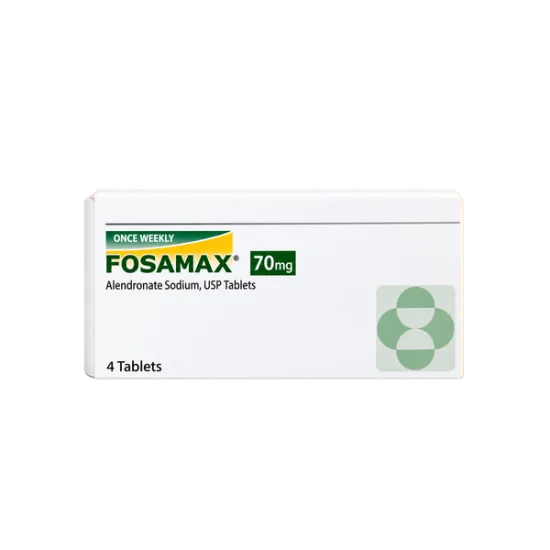
Fosamax
4 (3 customer reviews)Osteoporosis and other high-turnover bone conditions can weaken bone structure long before a fracture occurs. Fosamax contains alendronate sodium, a bisphosphonate tablet that slows bone breakdown by reducing osteoclast activity and helps preserve bone density.
Product information
Fosamax contains alendronate sodium, the sodium salt of alendronic acid. It belongs to the bisphosphonate class, medicines designed to bind to mineral surfaces in bone and reduce excessive bone resorption.
Active Ingredient and Chemical Classification
Alendronate is the active substance in Fosamax. Once absorbed, it localises mainly in areas where bone is being remodelled, which is the normal ongoing cycle of removing old bone and laying down new bone.
Ingredients
Fosamax contains alendronate sodium, the sodium salt of alendronic acid. It belongs to the bisphosphonate class, medicines designed to bind to mineral surfaces in bone and reduce excessive bone resorption.
Active Ingredient and Chemical Classification
Alendronate is the active substance in Fosamax. Once absorbed, it localises mainly in areas where bone is being remodelled, which is the normal ongoing cycle of removing old bone and laying down new bone.
Cellular Mechanism of Bone Preservation
Therapeutic indications
Fosamax is used for osteoporosis and selected disorders involving accelerated bone turnover. In clinical practice, doctors focus on fracture prevention, especially vertebral and hip fractures, rather than treating a symptom that a patient can immediately feel.
| Bone condition | Typical clinical goal |
|---|---|
| Postmenopausal osteoporosis | Preserve bone density and reduce fracture risk |
| Glucocorticoid-induced osteoporosis | Limit bone loss linked with long-term corticosteroid exposure |
| Paget’s disease of the bone | Reduce abnormally rapid bone turnover |
Management of Postmenopausal and Glucocorticoid-Induced Osteoporosis
Postmenopausal women are commonly prescribed alendronate when bone density is low or fracture risk is elevated. The fall in oestrogen after menopause can accelerate bone resorption, leaving vertebrae, wrists, and hips more vulnerable.
Glucocorticoid-induced osteoporosis can occur in adults using medicines such as prednisolone for inflammatory or autoimmune disease. Corticosteroids reduce bone formation and can increase bone resorption, so preventive treatment may be considered early when long-term exposure is expected. NICE guidance on osteoporosis assessment places prior fragility fracture, age, glucocorticoid use, and bone-density results among major factors guiding treatment decisions [2].
Treatment of Paget’s Disease of the Bone
Paget’s disease of the bone involves disorganised and accelerated bone remodelling. Bone may become enlarged, weaker, or painful, and some people develop deformity or fractures in affected areas.
Alendronate reduces the excess activity of osteoclasts in Paget’s disease. A clinician may track alkaline phosphatase, symptoms, and the affected skeletal site to judge the response.
Dosage and administration
Fosamax is supplied as oral tablets containing alendronate sodium. The amount taken at each intake is set individually for each person rather than being one fixed number.
For osteoporosis, the tablet is commonly used once weekly on the same chosen day. Paget’s disease and other treatment plans may use a different schedule selected by the prescriber.
- Take the tablet first thing in the morning after getting out of bed.
- Swallow it whole with a full glass of plain water.
- Do not eat, drink anything except plain water, or take other oral medicines for at least 30 minutes.
- Remain fully upright by sitting, standing, or walking for at least 30 minutes.
- Do not lie down until after the first food of the day.
Do not chew, suck, split, or crush the tablet. The main reason is not taste: direct contact with the mouth or oesophagus can increase the risk of irritation and ulceration.
A common mistake is taking Fosamax with a small sip of water while still in bed. Another is swallowing calcium, iron, magnesium, or a multivitamin at the same time. These minerals bind alendronate in the gut, so the medicine may not be absorbed.
Take Fosamax first, then wait at least 30 minutes before food, beverages other than water, vitamins, calcium, antacids, or other oral medicines.
When not to use it
Fosamax is contraindicated in people with an abnormality of the oesophagus that delays emptying, such as a stricture or achalasia, or in people who cannot remain upright for at least 30 minutes after taking it.
It is also contraindicated when blood calcium is low until that problem has been corrected. Avoid Fosamax in people who have had a serious allergic reaction to alendronate or another ingredient in the tablet.
- Significant swallowing difficulty or active upper gastrointestinal disease
- Severe kidney impairment
- Untreated vitamin D deficiency or other disorders of mineral metabolism
- Planned tooth extraction, dental implant work, or poorly healing oral lesions
- Pregnancy or breastfeeding
- Use in children and adolescents, since Fosamax is not routinely used under 18 for osteoporosis care
When this is not for you
Fosamax may not be suitable if swallowing is difficult, you have significant reflux or other upper digestive-tract problems, or you cannot sit or stand upright after taking the tablet. Tell a clinician before starting if you have kidney problems, low calcium or vitamin D, planned dental work, are pregnant or breastfeeding, or are under 18. A serious allergy to alendronate or another tablet ingredient also means it should be avoided.
Possible side effects
Fosamax is well tolerated by many people when its administration rules are followed precisely. Digestive and upper gastrointestinal effects are the main practical limitation, while severe reactions are uncommon but medically significant.
Commonly reported effects include abdominal pain, indigestion, nausea, acid reflux, constipation, diarrhoea, muscle pain, joint pain, and headache. Some aches can be difficult to separate from the underlying bone condition.
Gastrointestinal and Oesophageal Considerations
The most serious preventable complication is irritation of the oesophagus, the tube that carries food from the mouth to the stomach. Painful swallowing, pain behind the breastbone, new or worsening heartburn, or difficulty swallowing can indicate oesophageal injury.
Stop Fosamax and seek prompt medical assessment if these symptoms develop. The risk rises when the tablet is taken with insufficient water, taken before lying down, or used by someone with an oesophageal narrowing or impaired swallowing.
Rare Systemic Risks and Mineral Imbalances
Fosamax can lower blood calcium. Low calcium should be corrected before treatment starts, and vitamin D status may also need attention where deficiency is likely. Symptoms such as tingling around the mouth, persistent muscle cramps, or unusual spasms merit medical review.
Osteonecrosis of the jaw is rare in people taking osteoporosis doses, yet the risk increases with invasive dental procedures, poor oral health, cancer treatment, corticosteroids, and long exposure to antiresorptive therapy. Severe persistent jaw pain, exposed jaw bone, or poor healing after dental work requires prompt dental and medical assessment.
Atypical femoral fractures are also rare. New dull aching pain in the thigh, hip, or groin should not be ignored, especially when it persists on one side. The EMA product information for alendronic acid describes these uncommon but significant skeletal risks [3].

How it affects the body
Osteoclasts are cells that break down bone tissue. Fosamax suppresses osteoclast activity, slowing the rate at which bone mineral is lost. This does not create instant new bone; it gives bone-forming cells a better chance to rebuild and maintain skeletal strength over time. The FDA prescribing information describes alendronate as an inhibitor of osteoclast-mediated bone resorption [1].
Bone remodelling is necessary throughout adult life, yet osteoporosis develops when breakdown consistently exceeds rebuilding. Fosamax attaches to hydroxyapatite in bone and is taken up by osteoclasts during resorption. It then disrupts the osteoclast’s normal function, reducing further bone loss.
This mechanism helps explain why the benefit is measured through fracture-risk reduction and bone mineral density over months or years, not through a sensation felt after each tablet.
Common mistakes
Several patterns can undermine treatment or increase avoidable adverse effects.
- Taking Fosamax with coffee, juice, milk, or mineral water instead of plain water.
- Taking the tablet after breakfast rather than before the first food of the day.
- Lying back down after swallowing the tablet.
- Taking calcium, iron, antacids, or multivitamins during the first 30 minutes.
- Stopping treatment because no immediate physical change is felt.
- Ignoring persistent heartburn, painful swallowing, thigh pain, or jaw symptoms.
- Forgetting to mention Fosamax before invasive dental treatment.
Comparison
Fosamax is an oral bisphosphonate. Its key advantage is a well-established approach to reducing bone resorption without injections, while its main limitation is the strict fasting and upright administration routine.
| Treatment approach | Main distinction |
|---|---|
| Alendronate tablets | Oral bisphosphonate; requires fasting administration and remaining upright |
| Intravenous bisphosphonate | Avoids oesophageal exposure; administered in a clinical setting |
| Denosumab injection | Uses a different antiresorptive pathway and requires scheduled injections |
Doctors may favour an oral option when a patient can reliably follow the dosing rules and has no important oesophageal condition. An injection-based option may be considered when swallowing problems, persistent reflux, poor absorption, or adherence barriers make oral treatment impractical.
No option replaces adequate calcium intake, vitamin D where indicated, resistance exercise, fall prevention, and treatment of underlying causes of bone loss.
What doctors say
In clinical practice, doctors often find that Fosamax works best for people who treat its administration instructions as part of the prescription, not as optional details. A patient may take every scheduled tablet yet gain little benefit if calcium, breakfast, or coffee are taken too soon afterwards.
Doctors also set realistic expectations. Fosamax does not relieve osteoporosis overnight because osteoporosis is usually silent until a fracture occurs. Bone-density monitoring and fracture history provide more useful evidence of benefit than day-to-day sensations.
The World Health Organization identifies falls and fragility fractures as major contributors to disability in older adults. Bone-directed treatment is most useful when paired with mobility work, vision care, home fall-risk reduction, and nutrition suited to the person’s needs [4].
Common questions
How soon does the effect of Fosamax become noticeable?
Fosamax does not usually produce a feeling that signals it is working. Its effect is assessed through reduced bone turnover, bone-density testing, and lower fracture risk over time rather than a change felt after a dose. A clinician may arrange follow-up testing after an appropriate treatment interval based on fracture risk and prior scan results. EMA product information published in 2024 for alendronic acid explains that the medicine acts by reducing bone resorption rather than acting as a painkiller.
What should I do after a missed Fosamax dose?
For a once-weekly schedule, take the missed tablet on the morning after you remember it. Then resume the regular weekly schedule on the originally chosen day. Do not take two tablets on the same day, and do not take a later dose that day to compensate. The FDA instructions issued in 2012 specify this approach for weekly alendronate administration.
Which condition rules out Fosamax completely?
An oesophageal stricture, which narrows the oesophagus and delays emptying, rules out Fosamax because the tablet can remain in contact with the lining and cause injury. Achalasia is another relevant oesophageal disorder. The same applies if a person cannot sit or stand upright for the required period after dosing. EMA safety information from 2024 lists oesophageal abnormalities that delay emptying among the key contraindications.
Can older adults use Fosamax?
Older adults frequently use Fosamax because osteoporosis and fragility fractures become more common with age. Age alone does not rule it out, yet kidney function, swallowing ability, mobility, calcium status, vitamin D status, dental health, and the risk of falls should be considered. The WHO Integrated Care for Older People guidance, published in 2017, supports a broader assessment of fracture and fall risks in later life. A person who cannot remain upright after swallowing the tablet needs a different approach.
What should be checked or discussed before starting Fosamax?
Discuss prior fractures, bone-density results, kidney disease, reflux, ulcer history, swallowing problems, dental procedures, calcium intake, vitamin D status, and every prescription or non-prescription product taken regularly. Blood calcium should be corrected if low before starting therapy. Long-term corticosteroid use should also be discussed because it increases the risk of glucocorticoid-induced osteoporosis. NICE guidance from 2017 identifies fracture history, age, and glucocorticoid exposure as core elements of osteoporosis risk assessment.
What happens if Fosamax is stopped, and does it need tapering?
Fosamax does not require dose tapering because it is not a medicine that causes withdrawal symptoms. Its effects on bone turnover fade gradually after discontinuation, and the right time to stop or pause treatment depends on fracture risk, treatment duration, bone density, and any adverse effects. Do not stop it independently after a minor symptom without assessing whether the symptom could be managed or whether an alternative is more suitable. FDA information published in 2012 supports reassessment of ongoing bisphosphonate therapy according to individual fracture risk.
Do you offer anonymous delivery?
Your order will be securely packed and shipped within 24 hours. This is exactly what your package will look like (images of an actual item sent). It has the size and look of a regular private letter (24x11x0.7 cm) and its contents cannot be seen.
Sources
- U.S. Food and Drug Administration (2012). FOSAMAX (alendronate sodium) tablets and oral solution: Prescribing Information.
- National Institute for Health and Care Excellence (2017). Osteoporosis: assessing the risk of fragility fracture.
- European Medicines Agency (2024). Summary of Product Characteristics (SmPC) — Alendronic acid.
- World Health Organization (2017). Integrated care for older people: guidelines on community-level interventions to manage declines in intrinsic capacity.