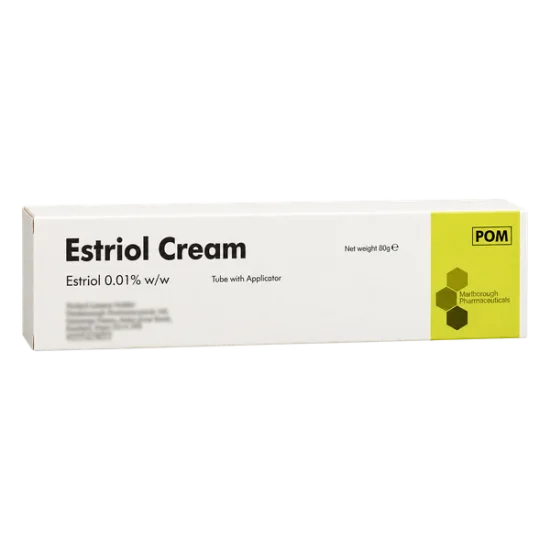
Estriol cream is applied intravaginally with an applicator to relieve local symptoms linked to reduced oestrogen after menopause. It is intended for women with vaginal dryness, soreness, itching, burning, and discomfort during intercourse. Estriol helps restore moisture, elasticity, and the protective mucosal barrier.
Product information
Estriol, also called E3, is a naturally occurring oestrogen. Estriol cream contains estriol 0.01% w/w and is used as a local vaginal oestrogen treatment rather than as full systemic hormone replacement therapy.
Compared with estradiol, or E2, estriol has weaker oestrogen-receptor activity. This lower potency is useful when treatment is directed at the vaginal tissues, where the goal is local symptom relief with limited absorption into the bloodstream.
Ingredients
Estriol, also called E3, is a naturally occurring oestrogen. Estriol cream contains estriol 0.01% w/w and is used as a local vaginal oestrogen treatment rather than as full systemic hormone replacement therapy.
Therapeutic indications
Lower oestrogen after menopause can thin the vaginal lining and change its natural acidity. This condition is often called genitourinary syndrome of menopause or menopausal atrophic vaginitis. The World Health Organization describes menopause as a normal life stage, yet its urogenital symptoms can persist without treatment. [1]
Estriol is used for local symptoms such as:
Vaginal dryness, burning, itching, or soreness
Painful intercourse, medically called dyspareunia
Fragile vaginal tissue that may bleed after friction
Recurrent urinary discomfort linked to menopausal tissue changes
Urgency, frequency, or mild urinary leakage where vaginal atrophy contributes
Recurrent lower urinary tract infections in postmenopausal women, when assessed as appropriate
In clinical practice, the first improvements are often less burning and easier daily comfort. Tissue elasticity and comfort during intercourse may take longer because the vaginal lining needs time to recover.
NICE guidance on menopause management supports vaginal oestrogen for genitourinary symptoms and recognises that treatment may be continued when symptoms remain troublesome. [2]
Practical tip: local oestrogen treats tissue changes. It does not protect against sexually transmitted infections, and it is not a contraceptive.
Dosage and administration
The supplied applicator helps place the cream inside the vagina, where estriol can act on the mucosa.
The individual dose is decided with age, other medicines, health conditions, and symptom severity in mind. Use is vaginal only.
A practical administration routine includes:
Apply the individually prescribed amount using the applicator.
Insert the applicator gently without force.
Apply at the scheduled time, often in the evening when this suits the treatment plan.
Do not use extra cream to compensate for a missed application.
If an application is missed, resume the planned schedule rather than doubling the next amount.
Practical tip: vaginal dryness can make applicator insertion uncomfortable at first. Applying the cream at the time specified in the individual treatment plan, often before sleep, can reduce leakage and make the routine easier.
When not to use it
Avoid Estriol or use it only under specialist direction if you have:
Current, previous, or suspected breast cancer
Known or suspected endometrial cancer or another oestrogen-dependent cancer
Untreated endometrial hyperplasia
Active or previous venous thromboembolism, including deep-vein thrombosis or pulmonary embolism
Known thrombophilia
Active arterial thromboembolic disease, such as recent stroke or heart attack
Acute liver disease or a history of liver disease where tests have not normalised
Porphyria
Undiagnosed genital bleeding
Extra caution is needed with a history of migraine, epilepsy, diabetes, hypertension, gallstones, endometriosis, uterine fibroids, or systemic lupus erythematosus. Medicines that induce liver enzymes, including some anti-seizure medicines, rifampicin, rifabutin, and St John’s wort, may alter oestrogen exposure.
The European Medicines Agency describes hormone therapy safety as dependent on the type of hormone, route of administration, dose, duration, and a woman’s individual risk factors. MOHAP-regulated clinical care follows the same principle of individual risk assessment.
When this is not for you
Estriol is not for you if you are pregnant, have unexplained vaginal bleeding, or have a known allergy to estriol or a cream ingredient.
Possible side effects
Most women tolerate local Estriol cream well, and local treatment generally produces fewer whole-body hormonal effects than systemic HRT. Mild local reactions can still occur, especially when vaginal tissue is very dry or inflamed.
Possible effects include:
Temporary vaginal irritation, itching, or burning
Increased vaginal discharge
Pelvic discomfort or mild cramping
Breast tenderness
Nausea
Headache
Light spotting or breakthrough bleeding
Fluid retention or bloating
Breast tension, nausea, and spotting can reflect oestrogen exposure. New bleeding after menopause needs assessment, even if it seems light or occurs shortly after starting treatment. This is a key distinction: local irritation may settle, while unexplained bleeding should never be treated as routine adjustment.
Estriol can occasionally affect cervical secretions. Women who use a barrier method for contraception should consider whether the cream base could affect the reliability of latex products; the product-specific prescribing information should guide this point.
Practical tip: a thin panty liner can be useful during the first applications if a small amount of cream leaks after insertion. Avoid scented washes or vaginal deodorants while irritated tissue is recovering, since they can worsen burning.
How it affects the body
Estriol acts mainly on vaginal and urinary tissues, helping restore moisture, elasticity, and the protective mucosal barrier.
Vaginal tissues contain oestrogen receptors. When oestrogen levels decline, these tissues can become thinner, drier, and more prone to irritation. Estriol helps support epithelial maturation, blood flow, lubrication, and a healthier local environment.
Estriol does not produce an immediate moisturising effect like a lubricant. It works by gradually improving the condition of oestrogen-sensitive tissue.
Common mistakes
Applying more cream after a missed dose instead of returning to the planned schedule
Stopping as soon as symptoms ease, then restarting only once discomfort becomes severe
Treating postmenopausal bleeding as a predictable cream effect
Assuming recurrent urinary burning is always a urinary infection
Using the cream externally only when the intended treatment is intravaginal
Combining several hormone products without a clinician reviewing the full regimen
Practical tip: keep a short symptom record covering dryness, burning, urinary urgency, intercourse discomfort, discharge, and bleeding. A clear pattern helps distinguish gradual tissue recovery from a problem that needs reassessment.
Comparison
Local Estriol cream has a different role from systemic HRT. Systemic oestrogen reaches the bloodstream and may be used for hot flushes, night sweats, and broader menopausal symptoms. Vaginal Estriol is directed mainly at local vaginal and urinary concerns.
Progesterone is often paired with systemic oestrogen in women with a uterus because it protects the endometrium from prolonged systemic oestrogen stimulation. Low-dose local vaginal oestrogen does not automatically require progesterone, though women with unexpected bleeding or complex hormone histories need individual review.
Testosterone, pregnenolone, and DHEA are separate hormones with different actions and should not be added casually to Estriol treatment. Vaginal DHEA may be considered for menopausal dyspareunia in some settings. Ospemifene is an oral selective oestrogen receptor modulator used for painful intercourse associated with menopause. These approaches suit different clinical circumstances.
The European Association of Urology includes local vaginal oestrogen among non-antibiotic measures that can reduce recurrent cystitis risk in postmenopausal women. [3]
What doctors say
Doctors usually focus on the symptom pattern before recommending local oestrogen. Dryness, recurrent irritation, pain with penetration, and repeated urinary symptoms after menopause often point toward oestrogen-deficient tissue, yet infection, skin conditions, prolapse, and abnormal bleeding require different care.
A realistic expectation is gradual improvement. Estriol improves the health of the vaginal lining over time; it is not a one-application solution for every cause of pelvic discomfort. The benefit is often most noticeable when treatment is used consistently according to the individual plan.
The main advantage is targeted action. The limitation is equally clear: Estriol cream will not treat severe hot flushes, depression, pelvic infection, or unexplained bleeding.
Common questions
Does Estriol cause breast tenderness?
Estriol can cause breast tenderness in some women because breast tissue responds to oestrogen. This is more likely to matter when a woman is also using systemic hormone therapy or has a history of hormone-sensitive symptoms. The 2022 North American Menopause Society position statement lists breast tenderness among potential hormone-related effects, though local vaginal therapy usually has lower systemic exposure. New breast symptoms, a lump, or persistent pain needs clinical assessment. A clinician should review symptoms that persist or worsen.
How does Estriol differ from estradiol?
Estriol and estradiol are both oestrogens, but estradiol has stronger receptor activity and is more commonly used in systemic HRT. Estriol cream is often selected for local vaginal symptoms because its action is directed toward vaginal and urinary tissue. NICE menopause guidance, updated in 2024, separates local vaginal oestrogen treatment from systemic HRT because their clinical aims and risk discussions differ. The best choice depends on whether symptoms are local, systemic, or both.
Can I drink alcohol while using Estriol?
Alcohol does not have a known direct interaction with local Estriol cream. Heavy alcohol intake may worsen sleep, flushing, mood changes, and dehydration, which can make menopausal symptoms feel more difficult to manage. The WHO menopause information page, published in 2022, supports attention to lifestyle factors that influence wellbeing during menopause. Alcohol should be limited if it triggers symptoms or if liver disease is part of your medical history.
Can I drive or work with machinery while using Estriol?
Local Estriol cream is not expected to impair alertness, concentration, coordination, or reaction time. It does not act as a sedative, so driving and working with machinery are generally unaffected. The Medsafe estriol cream data sheet published in 2024 reports no expected effect on the ability to drive or use machines. Do not drive if you develop dizziness, severe headache, or feel unwell for another reason.
What should I do if Estriol does not provide the expected relief?
Allow time for local tissue recovery while using Estriol according to the individual treatment plan. If dryness, pain, urinary symptoms, or recurrent discomfort continue, the cause may need reassessment because infection, pelvic floor dysfunction, vulval skin disease, or another condition may be involved. NICE guidance from 2024 supports review when symptoms persist despite vaginal oestrogen. New bleeding, pelvic pain, fever, or foul-smelling discharge requires prompt medical evaluation.
Do you offer anonymous delivery?
Your order will be securely packed and shipped within 24 hours. This is exactly what your package will look like (images of an actual item sent). It has the size and look of a regular private letter (24x11x0.7 cm) and its contents cannot be seen.
Sources
World Health Organization (2022). Menopause.
National Institute for Health and Care Excellence (2024). Menopause: diagnosis and management (NG23).
European Association of Urology (2025). EAU Guidelines on Urological Infections.
Reviews: Estriol
L
Layla, 63
Khalifa City
Verified
Rating: 2.5 out of 5
I stopped after the early applications because the burning did not settle for me and I developed spotting. I spoke with my doctor instead of continuing, as it was not the right experience for my symptoms.
10 Nov 2026
D
Divya N., 41
Al Qusais
Verified
Rating: 5 out of 5
The dryness had made exercise and long workdays uncomfortable. After using Estriol cream regularly, the soreness eased and I felt much more comfortable by the end of the first set of applications.
15 Oct 2026
A
Aisha, 39
Hatta
Verified
Rating: 5 out of 5
I used the cream for persistent irritation that had been bothering me in daily life. It made a clear difference to dryness and comfort, and the applicator was simple to use once I had established a routine.