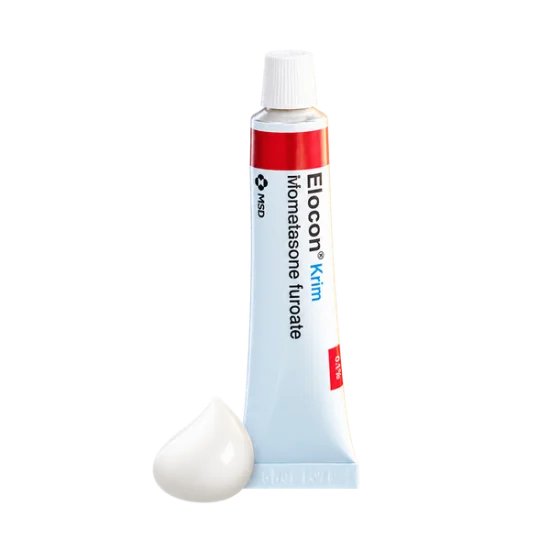
Elocon
4.2 (5 customer reviews)Elocon cream is applied as a thin layer to affected skin, usually once daily, with no food-related timing requirement. It contains mometasone furoate 0.1%, a topical corticosteroid for inflammatory conditions such as eczema, atopic dermatitis, and psoriasis. By reducing inflammatory signals in the skin, it eases redness, swelling, and itching.
Product information
Elocon contains mometasone furoate, a synthetic corticosteroid intended for topical use. The cream is applied directly to inflamed skin rather than taken by mouth. Its anti-inflammatory action makes it useful for corticosteroid-responsive dermatoses, including eczema, atopic dermatitis, plaque psoriasis, and selected cases of seborrheic dermatitis.
Ingredients
The active ingredient is mometasone furoate 0.1%. The cream base helps distribute the medicine across the skin and supports contact with the affected area. Excipients can vary by formulation and may irritate sensitive skin in people with known ingredient allergies.
Mometasone belongs to the corticosteroid class. These medicines reduce several inflammatory processes at once, which explains why redness, itching, and thickened plaques may improve together.
Therapeutic indications
Elocon is used for inflammatory skin disorders that respond to topical corticosteroids. The specific diagnosis matters because fungal, bacterial, viral, and parasitic rashes can worsen when treated with corticosteroids alone.
Common clinical uses include:
- Atopic dermatitis: reduces inflamed, itchy patches during a flare.
- Eczema: calms redness, scaling, irritation, and itch when inflammation is the main driver.
- Plaque psoriasis: may reduce raised, red, scaly plaques on suitable body areas.
- Seborrheic dermatitis: may be used for short courses when inflammation is prominent, especially under clinician direction.
- Other corticosteroid-responsive dermatoses: a prescriber may select it when the diagnosis and body site support topical corticosteroid treatment.
Elocon does not treat the underlying cause of every rash. A circular, spreading, or sharply bordered eruption may need assessment for a fungal infection before corticosteroid treatment continues.
Dosage and administration
Apply a thin film of Elocon cream to the affected area once daily unless the prescriber gives different instructions. Massage it in gently until absorbed. Wash the hands after application unless the hands are the treatment site.
Use the cream as follows:
- Apply only to the affected skin.
- Avoid the eyes, eyelids, lips, inside of the nose, and other mucous membranes.
- Do not cover the area with an airtight dressing unless a clinician specifically directs this.
- Keep treatment duration as short as needed to control the flare.
- Do not apply more often or in a thicker layer to speed up improvement.
- If a daily application is missed, apply it when remembered unless the next application is due soon; do not apply extra cream to compensate.
The appropriate amount and duration vary with the treated area, age, diagnosis, and response. Children and people with extensive disease may absorb a greater proportion through the skin.
For facial skin, folds, groin, and other thin-skin areas, use requires extra caution because these sites absorb corticosteroids more readily. Avoid self-extending treatment when the rash has improved; repeated unsupervised courses can increase the chance of skin thinning.
When not to use it
Do not use Elocon on a known untreated skin infection caused by fungi, bacteria, viruses, or parasites. It is also unsuitable for untreated rosacea, acne vulgaris, perioral dermatitis, or reactions caused by vaccination unless a clinician has given a specific plan.
Avoid application if you have previously experienced an allergic reaction to mometasone furoate or any ingredient in the cream. Do not place it in the eyes or use it on the eyelids without specific medical direction.
When this is not for you
Elocon is NOT for you if the rash may be infectious, the treatment area is unsuitable, or a clinician has advised against topical corticosteroids.
Extra caution is needed when:
- Treating the face, groin, armpits, or skin folds.
- Treating a child.
- Applying it to broken or ulcerated skin.
- Covering the area with a dressing.
- Treating a large body surface.
- Using other corticosteroid products at the same time.
- Having glaucoma, cataracts, or a history of raised eye pressure.
- Being pregnant or breastfeeding.
Application near the eyes can increase the risk of glaucoma and cataracts, especially with prolonged exposure. Accidental eye contact should be rinsed away promptly; persistent pain, blurred vision, halos, or light sensitivity require urgent clinical assessment.
Paediatric dermatology guidance from NICE supports limiting topical corticosteroid exposure to the affected areas and selecting potency according to the body site and severity [3].
Possible side effects
The most common reactions are local. Burning, stinging, itching, irritation, dryness, folliculitis, or redness can occur at the application site, especially during the first few applications or when the skin barrier is already damaged.
Longer or broader use can produce changes such as:
- Skin thinning or atrophy.
- Stretch marks.
- Easy bruising.
- Visible small blood vessels.
- Changes in skin colour.
- Increased hair growth at the application site.
- Acne-like eruptions or perioral dermatitis.
- Delayed healing of damaged skin.
Skin atrophy may be subtle at first. A shiny appearance, increased sensitivity, or a network of fine visible vessels can be an early sign that treatment needs reassessment.
Rarely, topical corticosteroids can be absorbed sufficiently to cause systemic effects. The risk rises with large treated areas, prolonged use, occlusive dressings, damaged skin, and treatment in infants or young children. The product information identifies possible suppression of the hypothalamic-pituitary-adrenal axis, visual complications, and growth effects in susceptible patients [2].
Stop applying the cream to a worsening rash and seek prompt medical assessment if there is spreading pain, pus, marked swelling, fever, or rapidly worsening redness. These features can indicate infection or another condition requiring different treatment.

How it affects the body
Mometasone furoate passes into skin cells and binds to intracellular glucocorticoid receptors. The resulting complex influences gene transcription and reduces the production of inflammatory mediators, including prostaglandins and leukotrienes. This lowers the activity of immune cells involved in redness, swelling, itching, and skin thickening.
The medicine also reduces the release of cytokines and other signalling proteins that maintain inflammation. Because the action occurs locally in the skin, the cream can calm a flare without requiring an oral corticosteroid for many limited-area conditions.
The FDA prescribing information describes mometasone furoate as a medium-to-high potency topical corticosteroid, depending on the formulation and treatment site [1]. Potency is not the same as treatment quality: stronger topical corticosteroids may work quickly, yet they also require tighter control of duration, area, and application frequency.
Common mistakes
Several habits reduce benefit or increase local risk:
- Applying a thick layer because the rash is severe.
- Using the cream on every itchy area without confirming that each area has the same diagnosis.
- Continuing treatment daily after inflammation has settled.
- Applying it under plastic wrap or a tight dressing without instructions.
- Using it on the face for longer than directed.
- Combining it with another steroid and unintentionally increasing exposure.
- Treating a suspected fungal rash with Elocon alone.
- Stopping moisturiser because the steroid has reduced redness.
- Applying it immediately before bathing, swimming, or vigorous exercise and washing it away.
- Sharing the tube with another person who has a different rash.
A common practical problem is applying the cream after washing while water still sits in the skin folds. Pat the area dry first, then apply a thin film to the affected skin.
Comparison
Elocon is selected for inflammatory skin disease, while other topical approaches target different mechanisms. The choice depends on the diagnosis, body site, severity, and whether infection is present.
| Treatment approach | Main action | Typical clinical role |
|---|---|---|
| Mometasone furoate cream | Reduces inflammatory immune signalling | Flares of eczema, dermatitis, psoriasis, and other corticosteroid-responsive rashes |
| Mild topical corticosteroid | Provides lower-intensity anti-inflammatory action | Sensitive sites, mild flares, or younger patients when suitable |
| Topical antifungal treatment | Suppresses fungal growth | Confirmed or suspected fungal skin infection |
A topical corticosteroid may be combined with an antimicrobial approach only when the diagnosis justifies it. Using a corticosteroid alone on an untreated fungal infection can reduce redness temporarily while allowing the infection to spread.
For psoriasis, topical corticosteroids can reduce plaques, yet maintenance planning matters because frequent repeated use over the same area may cause local adverse effects. For atopic dermatitis, moisturising remains useful between flares because Elocon controls inflammation but does not replace regular barrier care.
What doctors say
In clinical practice, doctors usually judge Elocon by the change in inflammation, itch, sleep disruption, and skin texture rather than by the amount of cream used. A small amount applied correctly may control a flare more reliably than repeated heavy applications.
A dermatologist will usually ask where the rash is located, how long it has been present, whether it spreads, and whether anyone else has similar symptoms. Those details help distinguish eczema or psoriasis from fungal infection, scabies, contact dermatitis, and bacterial disease.
The main clinical trade-off is clear: mometasone can calm inflammation efficiently, but treatment becomes less suitable when used continuously, over extensive areas, or on thin skin without review. The European Medicines Agency describes topical corticosteroids within a risk-benefit framework that depends on potency, duration, treated area, and patient age [4].
One practical point is often missed. If a rash improves while using Elocon and returns quickly after stopping, the issue may be an unresolved trigger, infection, allergen, or need for a maintenance strategy rather than a reason to keep applying more cream.
Common questions
Can Elocon affect driving, concentration, or work with machinery?
Elocon is applied to the skin and is not expected to impair alertness, concentration, or coordination when used as directed. The FDA product information from 2019 does not identify a direct driving restriction for topical mometasone furoate . Irritation, pain, blurred vision after accidental eye exposure, or a severe skin flare could still make driving or machinery work unsafe until the problem settles.
Which concrete condition rules out Elocon?
An untreated fungal skin infection is a concrete reason to avoid using Elocon alone. Corticosteroids can suppress visible inflammation while the fungal infection continues, making the rash harder to recognise. WHO guidance published in 2014 supports choosing treatment directed at a confirmed fungal infection rather than relying on anti-inflammatory treatment alone.
What happens after stopping Elocon, and does it need tapering?
Short courses on limited areas generally do not require tapering, but a flare can return if the underlying dermatitis or psoriasis remains active. Rebound redness, burning, or widespread worsening after prolonged frequent use needs medical assessment rather than repeated unsupervised applications. NICE guidance updated in 2021 supports adjusting topical corticosteroid use according to disease severity, body site, response, and treatment duration .
What should be discussed with a doctor before starting Elocon?
Mention any rash around the eyes, facial rash, suspected infection, glaucoma, cataracts, pregnancy, breastfeeding, or previous reaction to topical corticosteroids. Tell the clinician about other steroid creams, dressings, and medicines used on the same skin area. MOHAP clinical practice guidance published in 2022 places emphasis on appropriate diagnosis and medicine use, which is especially relevant when a corticosteroid is being considered for a persistent or recurrent rash.
Do diet, exercise, or daily habits help or hinder the result?
Diet does not directly neutralise mometasone furoate, but habits that damage the skin barrier can prolong inflammation. Hot showers, fragranced products, scratching, sweating trapped under tight clothing, and repeated friction may hinder improvement in eczema or dermatitis. The American Academy of Dermatology guidance published in 2021 supports gentle skin care and regular moisturising as part of topical management for inflammatory skin disease.
Do you offer anonymous delivery?
Your order will be securely packed and shipped within 24 hours. This is exactly what your package will look like (images of an actual item sent). It has the size and look of a regular private letter (24x11x0.7 cm) and its contents cannot be seen.
Sources
- U.S. Food and Drug Administration (2019). ELOCON (mometasone furoate) Cream, Ointment, and Lotion Prescribing Information.
- DailyMed (2023). Mometasone Furoate Cream — Prescribing Information.
- National Institute for Health and Care Excellence (2021). Atopic eczema in under 12s: diagnosis and management.
- European Medicines Agency (2018). Guideline on the clinical investigation of medicinal products indicated for the treatment of psoriasis.