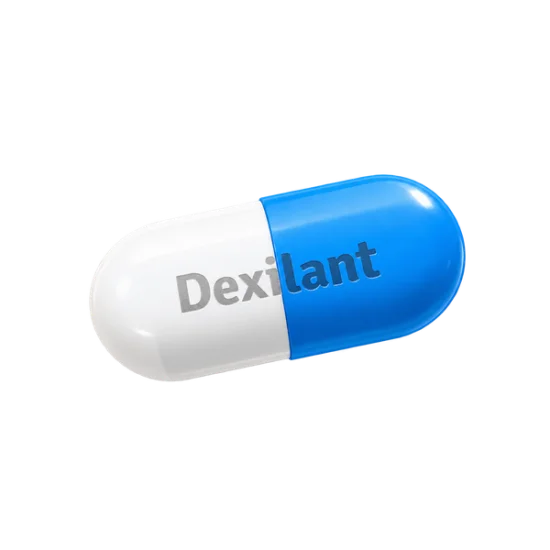
Dexilant is intended for people with acid reflux and gastro-oesophageal reflux disease. Its active ingredient, dexlansoprazole, reduces stomach acid and supports healing of acid-related damage to the oesophagus.
Product information
Dexilant capsules are taken by mouth once daily, with or without food, to treat acid reflux. They contain dexlansoprazole, which reduces stomach acid in people with gastro-oesophageal reflux disease (GERD) and helps heal acid-related damage to the oesophagus. Their dual delayed-release design supports acid suppression across the day.
Ingredients
Dexilant contains dexlansoprazole, a proton pump inhibitor (PPI). Dexlansoprazole is the R-enantiomer of lansoprazole: it has the same chemical components arranged in a different three-dimensional form. Its purpose is to reduce acid production, giving an irritated oesophagus time to heal.
The capsule contains two groups of delayed-release granules. They release dexlansoprazole at different points as the capsule passes through the digestive tract, producing two rises in drug concentration. Neither group is designed to release its contents immediately on swallowing. The FDA prescribing information describes this dual delayed-release action and the capsule’s administration options [1].
Dexlansoprazole blocks the gastric proton pump, an enzyme in stomach-lining cells that performs the final step of acid secretion. Acid suppression reduces the amount of acid available to flow back into the oesophagus. It does not physically stop reflux, so symptoms caused mainly by non-acid reflux may persist.
Keep the delayed-release granules intact. Crushing or chewing them defeats the design that controls when dexlansoprazole is released.
Therapeutic indications
Dexilant is used to heal erosive oesophagitis, maintain healing after erosions have resolved, and relieve heartburn associated with symptomatic, non-erosive GERD. Erosive oesophagitis means stomach acid has caused visible breaks in the lining of the oesophagus; non-erosive GERD can still cause troublesome heartburn without those visible breaks.
Treatment expectations differ between the two conditions. Heartburn may ease before damaged tissue has healed, so early symptom relief does not establish that an erosion has resolved. Conversely, persistent burning does not always mean acid suppression has failed: reflux that is less acidic, oesophageal sensitivity and other conditions can produce similar symptoms.
The American College of Gastroenterology’s GERD guideline distinguishes symptom control from healing and recommends investigating persistent or alarm symptoms rather than repeatedly changing acid-suppressing treatment without assessment [2]. Difficulty swallowing, food sticking, vomiting blood, black stools or unexplained weight loss warrant prompt medical evaluation.
Dosage and administration
Route and frequency: Take Dexilant by mouth once daily at the prescribed dose. The amount and treatment duration are selected for the condition being treated.
Food and timing: It can be taken with or without food. Choosing a consistent time of day can make daily use easier.
Swallowing: Swallow the capsule whole. If swallowing capsules is difficult, the capsule can be opened and its intact granules sprinkled onto a spoonful of applesauce, then swallowed immediately without chewing.
Missed dose: Take it when remembered unless the next scheduled dose is close. Skip the missed dose in that case; do not double up.
The flexibility around meals is useful, but it does not make Dexilant an on-demand treatment for sudden heartburn. A regular schedule is more appropriate when the aim is sustained acid suppression or oesophageal healing.
If using applesauce, swallow the granules immediately. Chewing them or saving the mixture for later changes the intended administration.
A missed morning capsule does not call for two capsules the next morning. Return to the usual once-daily schedule.
When not to use it
Dexilant is not for you if you have had a serious allergic reaction to dexlansoprazole or another component of the medicine, or if you take a rilpivirine-containing medicine. A previous severe reaction to another PPI also needs careful review before treatment.
When this is not for you
Dexilant may not be suitable if you have had a serious allergic reaction to dexlansoprazole, another PPI or one of the medicine’s components. It also needs careful review if you have kidney or significant liver disease, osteoporosis, low magnesium, or are pregnant or breastfeeding. Do not use it with a rilpivirine-containing medicine.
Possible side effects
The adverse effects reported with dexlansoprazole include diarrhoea, abdominal discomfort, nausea, vomiting and gas. These effects are often mild, but persistent diarrhoea deserves attention. Severe watery diarrhoea, especially with fever or abdominal pain, may signal an intestinal infection associated with acid-suppressing treatment.
A new rash, facial swelling or breathing difficulty calls for urgent help. Severe skin reactions and kidney inflammation have also been reported with PPIs. Signs that need assessment include a widespread blistering rash, reduced urination or unexplained fatigue alongside other new symptoms.
Longer-term PPI treatment can be associated with low magnesium, vitamin B12 deficiency and an increased risk of certain infections or fractures in susceptible patients. These possibilities do not mean everyone needs routine supplements or testing. The reason for ongoing treatment, other medicines and individual risk factors determine what monitoring is useful.
How it affects the body
Dexlansoprazole blocks the gastric proton pump, an enzyme in stomach-lining cells that performs the final step of acid secretion. Acid suppression reduces the amount of acid available to flow back into the oesophagus. It does not physically stop reflux, so symptoms caused mainly by non-acid reflux may persist.
Common mistakes
Using Dexilant only when heartburn starts. Its role is sustained acid suppression, so intermittent use may be a poor fit for a healing course.
Stopping a healing course as soon as burning settles. Symptom relief and healing of erosive oesophagitis are different outcomes.
Chewing granules after opening a capsule. The granules must remain intact for delayed release.
Taking an extra capsule after a missed dose. Doubling up does not restore the missed day’s schedule.
Treating persistent swallowing difficulty as ordinary reflux. Food sticking requires assessment even when heartburn improves.
Comparison
Dexilant’s dual delayed-release design distinguishes it from several other PPIs. The most useful comparison is the treatment goal, rather than an assumption that one medicine will work best for everyone.
Approach
How it reduces symptoms
Practical distinction
Dexilant (dexlansoprazole)
Suppresses acid production through the proton pump
Dual delayed release; dosing is flexible around meals
Lansoprazole or omeprazole
Suppresses acid production through the proton pump
Other PPIs may have different meal-timing instructions
Antacids
Neutralise acid already in the stomach
Can relieve an occasional episode but do not provide the same sustained acid suppression
Lansoprazole and dexlansoprazole are closely related substances. Their formulations and dosing instructions still differ. An antacid may be useful for a brief breakthrough symptom, while a PPI is suited to a planned course of acid suppression. Neither approach explains persistent chest pain or difficulty swallowing.
What doctors say
In clinical practice, the first question is whether the treatment goal is relief of heartburn, healing of confirmed erosions, or maintenance after healing. That distinction shapes the prescribed course and the point at which symptoms should be reassessed. A clinician will also review medicines affected by stomach acidity before selecting a PPI.
Persistent symptoms call for a closer look at the pattern. Burning after late meals, symptoms when lying down and regurgitation can coexist, yet they may not all respond equally to stronger acid suppression. The NICE guidance on reflux and dyspepsia supports reviewing the diagnosis and treatment response when symptoms continue [3]. PubMed indexes related studies, and Cochrane reviews synthesize evidence relevant to treatment decisions.
Common questions
What should I do if Dexilant does not give the expected result?
A lack of improvement calls for a review of the diagnosis, the prescribed routine and any alarm symptoms. The American College of Gastroenterology’s 2022 GERD guideline discusses further assessment when symptoms persist despite PPI treatment. In a 2026 treatment review, mention whether the main problem is burning, regurgitation or difficulty swallowing, since these symptoms can have different causes. Do not increase the dose independently. A clinician may consider testing or another explanation for persistent symptoms.
How soon might I notice an effect?
Acid suppression begins after dosing, but noticeable symptom relief varies between people. Dexilant is intended for regular treatment rather than immediate rescue from a sudden episode of heartburn. The FDA’s prescribing information describes its acid-suppressing action; it does not promise that every person will feel relief after the first capsule. During a 2026 course of treatment, improvement in burning should also be distinguished from healing of oesophageal erosions.
How long does one dose keep working?
Dexilant’s two delayed-release phases help extend acid suppression across a once-daily dosing interval. The FDA describes this formulation in its prescribing information, rather than guaranteeing a fixed number of symptom-free hours for every patient. In 2026, persistent symptoms before the next scheduled dose remain a useful detail to report during treatment review. Do not take an extra capsule solely because heartburn returns.
Which condition rules out Dexilant?
A previous serious allergic reaction to dexlansoprazole rules out its use. The FDA prescribing information also lists concomitant treatment with a rilpivirine-containing medicine as a contraindication because acid suppression reduces rilpivirine absorption. This interaction remains relevant to a medication review in 2026 even when the two medicines would be taken at different times. Breathing difficulty or facial swelling after a dose requires urgent medical attention.
How does Dexilant differ from lansoprazole?
Dexlansoprazole is the R-enantiomer of lansoprazole, and both medicines inhibit the stomach’s proton pump. Dexilant uses a dual delayed-release formulation, which allows dosing without coordinating the capsule with meals. The American College of Gastroenterology’s 2022 guideline considers PPIs as a class while recognising that response can differ between individuals. For a treatment choice in 2026, the relevant differences are the prescribed goal, administration routine, interactions and personal response.
Do you offer anonymous delivery?
Your order will be securely packed and shipped within 24 hours. This is exactly what your package will look like (images of an actual item sent). It has the size and look of a regular private letter (24x11x0.7 cm) and its contents cannot be seen.
Sources
FDA (2017). DEXILANT (dexlansoprazole) delayed-release capsules: Prescribing Information.
American College of Gastroenterology (2022). ACG Clinical Guideline: Diagnosis and Management of Gastroesophageal Reflux Disease.
NICE (2019). Gastro-oesophageal reflux disease and dyspepsia in adults: investigation and management (CG184).
Reviews: Dexilant
A
Ali, 41
Al Dhaid
Four weeks
Verified
Rating: 5 out of 5
I took Dexilant once daily for four weeks for persistent burning after meals. The episodes became less frequent, and I could get through the evening without the usual discomfort. Keeping the same time each day was straightforward.
13 Oct 2026
A
Ahmed, 38
Al Ain
Three weeks
Verified
Rating: 2 out of 5
I took Dexilant once daily for three weeks, but the burning did not improve enough for me. I also had troublesome diarrhoea, so I stopped and discussed the symptoms with my doctor.
28 Oct 2026
H
Hamza C., 27
Ajman
Two weeks
Verified
Rating: 5 out of 5
I used Dexilant once daily for two weeks for reflux that had been bothering me at night. The burning eased during the course, and I was satisfied that I could take the capsule without planning it around breakfast.