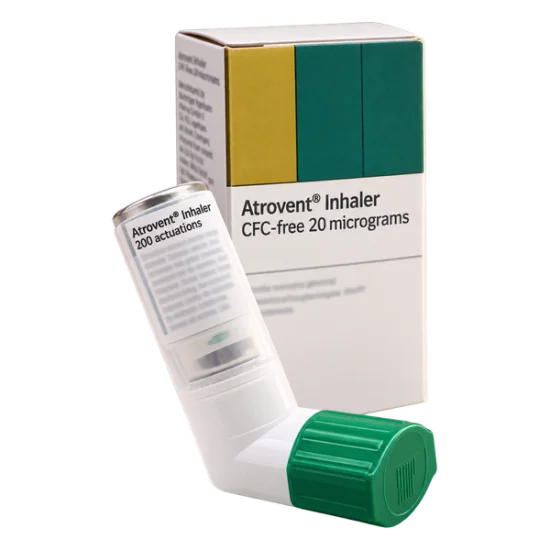
Atrovent
4.4 (4 customer reviews)Atrovent is a pressurised inhaler taken by mouth into the lungs to ease airway narrowing in adults with chronic obstructive pulmonary disease (COPD), including chronic bronchitis and emphysema. Its active ingredient, ipratropium bromide, relaxes airway muscles by blocking acetylcholine, helping reduce wheeze, chest tightness, and breathlessness.
Product information
Atrovent contains ipratropium bromide, an anticholinergic bronchodilator. It acts locally in the airways and is used for the maintenance treatment of bronchospasm linked to COPD.
Ingredients
Atrovent contains ipratropium bromide, an anticholinergic bronchodilator. It acts locally in the airways and is used for the maintenance treatment of bronchospasm linked to COPD. It is not designed as the sole treatment for a sudden, severe breathing attack.
Ipratropium bromide belongs to the same broad chemical family as atropine, yet its inhaled route limits absorption into the bloodstream for most users. This is why its effects are directed mainly at the bronchial tubes rather than throughout the body.
Therapeutic indications
Atrovent is used to manage bronchospasm, meaning tightening of the airway muscles that restricts airflow. COPD is the main long-term indication, including chronic bronchitis and emphysema. In selected asthma plans, clinicians may add ipratropium during acute exacerbations when symptoms are severe or when response to a short-acting beta-2 agonist is insufficient.
The Global Initiative for Chronic Obstructive Lung Disease, known as GOLD, lists short-acting antimuscarinic bronchodilators among treatment options for symptom relief in COPD. The choice depends on symptom pattern, exacerbation history, inhaler technique, and the rest of the respiratory treatment plan. [2]
Atrovent does not treat lung infection, remove mucus plugs, or reverse structural lung damage from COPD. It improves airflow by reducing the muscle tightening that contributes to breathlessness.
Respiratory treatment roles
| Clinical situation | Role of Atrovent |
|---|---|
| Stable COPD with bronchospasm | Helps maintain open airways and reduce symptoms |
| Chronic bronchitis or emphysema | May reduce wheeze and breathlessness related to airway narrowing |
| Severe asthma episode | May be used as an add-on under clinical direction |
Dosage and administration
Atrovent is a pressurised metered-dose inhaler with 200 actuations. Each actuation releases a measured aerosol dose that should travel deep into the lungs rather than remain in the mouth or throat.
The device needs coordination: start to breathe in slowly, press once, then continue a slow deep inhalation. A spacer may be useful for people who find it difficult to coordinate pressing and breathing in at the same time. This can reduce throat deposition and improve the amount reaching the lower airways.
Administration routine
- Use Atrovent only by inhalation through the mouth.
- Follow the regimen confirmed with a healthcare professional before starting.
- Sit or stand upright before use.
- Breathe out fully, away from the mouthpiece.
- Seal the lips around the mouthpiece and begin a slow inhalation.
- Press the canister once while breathing in steadily.
- Hold the breath briefly, if comfortable, before breathing out slowly.
- If another actuation is prescribed, wait briefly and repeat the same technique.
When not to use it
- Narrow-angle glaucoma or a history of sudden pressure rises in the eye.
- Enlarged prostate, bladder-neck obstruction, or previous urinary retention.
- Use of other anticholinergic medicines, since combined effects can increase dry mouth, constipation, blurred vision, and difficulty urinating.
- Pregnancy or breastfeeding, where treatment should be tailored to the mother’s respiratory control and clinical history.
- A previous episode of paradoxical bronchospasm after an inhaled medicine.
When this is not for you
Atrovent is not for you if you have had a hypersensitivity reaction to ipratropium bromide, atropine, or related anticholinergic medicines. Signs of a serious allergy include facial swelling, widespread hives, throat tightness, or difficulty breathing after use.
Anticholinergic effects can be easy to miss at first. A person may blame dehydration for dry mouth or assume urinary hesitancy is age-related, yet these symptoms can be relevant when they appear after starting or increasing anticholinergic treatment.
Possible side effects
Most Atrovent side effects relate to its anticholinergic action. Dry mouth, throat irritation, cough, headache, nausea, and an unpleasant taste may occur. These effects are often mild, yet persistent symptoms deserve attention because poor tolerability can lead people to skip doses.
Eye exposure needs care. Aerosol entering the eyes may cause eye pain, blurred vision, halos around lights, or worsening of narrow-angle glaucoma. This is more likely with poor inhaler positioning or when aerosol escapes around an ill-fitting spacer.
Serious reactions are uncommon but need prompt attention. Paradoxical bronchospasm means breathing becomes suddenly worse soon after inhalation. Stop using Atrovent and seek urgent medical assessment if wheezing, chest tightness, or breathlessness rapidly intensifies after a dose. Urgent assessment can distinguish a reaction from worsening disease. Fast heartbeat, palpitations, allergic swelling, rash, difficulty passing urine, or new eye pain also need clinical review. [3]
How it affects the body
The airways contain muscarinic receptors that respond to acetylcholine, a natural nerve messenger. When acetylcholine attaches to these receptors, bronchial smooth muscle can tighten and mucus secretion may increase. Ipratropium bromide competitively blocks this signal.
That receptor blockade reduces vagally mediated bronchoconstriction. The result is wider airways and less resistance to airflow, which can make daily activities such as walking, climbing stairs, or washing easier for people with COPD. Its mechanism differs from beta-2 agonist inhalers, which relax airway muscle by stimulating beta-2 receptors rather than blocking acetylcholine. [1]
Atrovent works locally in the lungs.
Common mistakes
Several errors can reduce the benefit of Atrovent or increase unwanted effects.
- Using it as the only response to a sudden, severe asthma attack.
- Spraying before beginning to inhale.
- Taking a quick gasp instead of a slow, deep breath.
- Letting aerosol drift toward the eyes.
- Continuing despite sudden worsening of wheeze after an actuation.
- Combining several anticholinergic medicines without reviewing the total anticholinergic burden.
- Assuming a nearly empty inhaler still delivers a consistent full dose.
A common practical issue is losing track of actuations. Since this inhaler contains 200 actuations, counting routine use from the start helps prevent an unexpected interruption in treatment.
Comparison
Atrovent is often selected when an anticholinergic mechanism suits the person’s respiratory plan. It can be used alongside other bronchodilator classes when prescribed, but the medicines do different jobs.
| Approach | Main mechanism | Typical role |
|---|---|---|
| Ipratropium bromide in Atrovent | Blocks muscarinic acetylcholine receptors | COPD symptom relief and selected acute asthma plans |
| Short-acting beta-2 agonist | Stimulates beta-2 receptors to relax airway muscle | Faster rescue relief from bronchospasm |
| Inhaled corticosteroid | Reduces airway inflammation | Prevention of asthma symptoms and exacerbations in selected patients |
Short-acting beta-2 agonists usually begin working faster than ipratropium, so they often remain central to immediate rescue treatment. Atrovent can provide useful additional bronchodilation, especially where cholinergic airway tightening contributes to symptoms. In asthma, inhaled corticosteroids address inflammation, while Atrovent does not.
What doctors say
In respiratory practice, clinicians look beyond the inhaler itself. They assess the diagnosis, baseline breathlessness, smoking exposure, recent flare-ups, oxygen levels where relevant, and whether the person can use a pressurised inhaler correctly.
Doctors often find that poor technique explains an apparent lack of benefit. Pressing the canister before inhaling, breathing in too quickly, or stopping the breath immediately after actuation can leave little medicine in the lungs. A technique review can change outcomes without altering the regimen.
For people with COPD, regular symptom control and prevention of exacerbations shape treatment decisions. WHO identifies chronic respiratory diseases as a major cause of long-term illness worldwide, and sustained exposure to tobacco smoke, indoor pollutants, or occupational irritants can continue to worsen symptoms even when bronchodilator treatment is used. [4]
Common questions
Can Atrovent be used under 18?
Atrovent may be used in children only when a clinician has selected it for the child’s specific respiratory condition and inhaler technique. Children may struggle with coordination needed for a pressurised inhaler, so a spacer or another delivery approach may be considered. The Global Initiative for Asthma describes ipratropium as an add-on option in acute severe asthma management rather than routine stand-alone asthma control. GINA guidance published in 2025 supports individualised asthma plans for younger patients. [5]
Which diet, exercise, and habits can help or hinder treatment results?
Atrovent has no meaningful food interaction because it is inhaled into the lungs rather than taken through the digestive system. Stopping smoking and reducing exposure to shisha smoke, dust, strong fumes, and indoor combustion particles can reduce ongoing airway irritation. Pulmonary rehabilitation, paced walking, and breathing exercises may improve exercise tolerance in COPD when matched to a clinician-led plan. WHO information published in 2024 links tobacco exposure and air pollution with chronic respiratory disease burden.
How does Atrovent differ from the closest alternative by mechanism?
Atrovent blocks acetylcholine at muscarinic receptors, while a short-acting beta-2 agonist stimulates beta-2 receptors on airway muscle. Both approaches relax narrowed airways, but their onset, role, and side-effect profile differ. Beta-2 agonists can cause tremor or palpitations, whereas Atrovent more often causes dry mouth or local throat effects. EMA product information from 2024 describes this receptor-blocking action as distinct from beta-2 receptor stimulation.
Can I drive or work with machinery while using Atrovent?
Most people can drive and work normally when Atrovent does not cause visual changes, dizziness, or eye symptoms. Do not drive or operate machinery if you develop blurred vision, eye pain, dizziness, or difficulty focusing after use. These symptoms matter because accidental eye exposure can trigger acute eye effects in susceptible people. Product safety information from the FDA published in 2024 advises attention to ocular effects and paradoxical bronchospasm.
What should be discussed with a doctor before starting Atrovent?
Discuss your respiratory diagnosis, recent flare-ups, current inhalers, allergies to atropine-related medicines, glaucoma, prostate enlargement, and any past urinary retention. Mention all medicines with anticholinergic properties, including treatments for bladder symptoms, motion sickness, or certain neurological conditions. A clinician should also confirm the regimen for the chosen strength before you start. MOHAP guidance from 2024 encourages medication use within an individualised clinical plan, especially for long-term respiratory disease.
How should the Atrovent device be cleaned and handled?
Remove the mouthpiece cover and clean the mouthpiece regularly with warm water, allowing it to dry fully before reassembly. Do not use sharp objects to clear the opening because damage can alter the spray pattern. Keep the canister fitted correctly in its actuator and protect the mouthpiece from dust between uses. The manufacturer’s handling instructions, reflected in the 2024 DailyMed prescribing information, should guide priming after a prolonged period without use.
What is the correct technique for using the Atrovent inhaler?
Begin seated or standing upright, then breathe out away from the mouthpiece. Place the mouthpiece between the lips, begin a slow deep breath in, and press the canister once at the same time. Continue inhaling steadily, hold the breath briefly if comfortable, then breathe out slowly. Respiratory guidelines from GOLD, updated in 2025, emphasise repeated inhaler-technique assessment because correct use directly affects lung delivery.
Do you offer anonymous delivery?
Your order will be securely packed and shipped within 24 hours. This is exactly what your package will look like (images of an actual item sent). It has the size and look of a regular private letter (24x11x0.7 cm) and its contents cannot be seen.
Sources
- U.S. National Library of Medicine, DailyMed (2024). ATROVENT HFA — ipratropium bromide aerosol, metered: Prescribing Information.
- Global Initiative for Chronic Obstructive Lung Disease (2025). Global Strategy for the Diagnosis, Management, and Prevention of COPD.
- U.S. Food and Drug Administration (2024). ATROVENT HFA Prescribing Information.
- World Health Organization (2024). Chronic respiratory diseases.
- Global Initiative for Asthma (2025). Global Strategy for Asthma Management and Prevention.